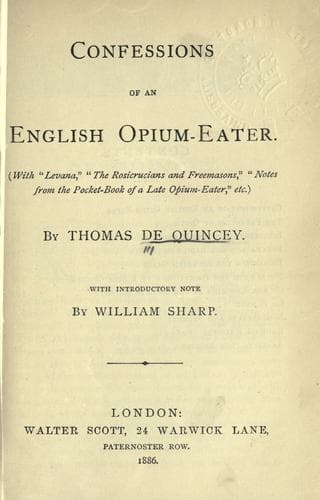
Note Book of an English Opium-EaterDe Quincey, Thomas
Philosophy
Note Book of an English Opium-Eater
De Quincey, Thomas
Opium abuse -- England
That kind of feeling, which broods over the Grecian tragedy, and to court
which feeling the tragic poets of Greece naturally spread all their
canvas, was more nearly allied to the atmosphere of death than that of
life. This expresses rudely the character of awe and religious horror
investing the Greek theatre. But to my own feeling the different principle
of passion which governs the Grecian conception of tragedy, as compared
with the English, is best conveyed by saying that the Grecian is a
breathing from the world of sculpture, the English a breathing from the
world of painting. What we read in sculpture is not absolutely death, but
still less is it the fulness of life. We read there the abstraction of a
life that reposes, the sublimity of a life that aspires, the solemnity of
a life that is thrown to an infinite distance. This last is the feature of
sculpture which seems most characteristic: the form which presides in the
most commanding groups, 'is not dead but sleepeth:' true, but it is the
sleep of a life sequestrated, solemn, liberated from the bonds of space
and time, and (as to both alike) thrown (I repeat the words) to a
distance which is infinite. It affects us profoundly, but not by
agitation. Now, on the other hand, the breathing life--life kindling,
trembling, palpitating--that life which speaks to us in painting, this is
also the life that speaks to us in English tragedy. Into an English
tragedy even festivals of joy may enter; marriages, and baptisms, or
commemorations of national trophies: which, or any thing _like_ which, is
incompatible with the very being of the Greek. In that tragedy what
uniformity of gloom; in the English what light alternating with depths of
darkness! The Greek, how mournful; the English, how tumultuous! Even the
catastrophes how different! In the Greek we see a breathless waiting for a
doom that cannot be evaded; a waiting, as it were, for the last shock of
an earthquake, or the inexorable rising of a deluge: in the English it is
like a midnight of shipwreck, from which up to the last and till the final
ruin comes, there still survives the sort of hope that clings to human
energies.
Public-domain text, read in full here on John Shaqi.
Reviews
Reviews
No reviews yet
Be the first to share your thoughts on this work.
Elsewhere in the archive
Join the Discussion
Join the discussion
Sign in to leave a comment or review.
Sign InorCreate an account