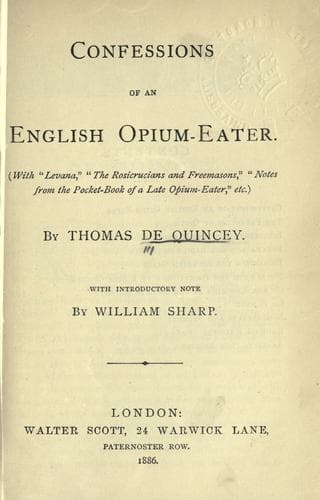
Note Book of an English Opium-EaterDe Quincey, Thomas
Philosophy
Note Book of an English Opium-Eater
De Quincey, Thomas
Opium abuse -- England
conceive that any interloper into the Greek chorus must have danced when
_they_ danced, or he would have been swept away by their impetus:
_nolens volens_, he must have rode along with the orchestral charge,
he must have rode on the crest of the choral billows, or he would have
been rode down by their impassioned sweep. Samson, and Oedipus, and
others, must have danced, if they sang; and they certainly _did_ sing, by
notoriously intermingling in the choral business.[6]
'But now,' says the plain English reader, 'what was the object of all
these elaborate devices? And how came it that the English tragedy, which
surely is as good as the Greek,' (and at this point a devil of defiance
whispers to him, like the quarrelsome servant of the Capulets or the
Montagus, 'say _better_,') 'that the English tragedy contented itself
with fewer of these artful resources than the Athenian?' I reply, that the
object of all these things was--to unrealize the scene. The English drama,
by its metrical dress, and by other arts more disguised, unrealized
itself, liberated itself from the oppression of life in its ordinary
standards, up to a certain height. Why it did not rise still higher, and
why the Grecian _did_, I will endeavor to explain. It was not that the
English tragedy was less impassioned; on the contrary, it was far more
so; the Greek being awful rather than impassioned; but the passion of each
is in a different key. It is not again that the Greek drama sought a lower
object than the English: it sought a different object. It is not imparity,
but disparity, that divides the two magnificent theatres.
Suffer me, reader, at this point, to borrow from my-self, and do not
betray me to the authorities that rule in this journal, if you happen to
know [which is not likely] that I am taking an idea from a paper which
years ago I wrote for an eminent literary journal. As I have no copy of
that paper before me, it is impossible that I should save myself any labor
of writing. The words at any rate I must invent afresh: and, as to the
idea, you never _can_ be such a churlish man as, by insisting on a new
one, in effect to insist upon my writing a false one. In the following
paragraph, therefore, I give the substance of a thought suggested by
myself some years ago.
Public-domain text, read in full here on John Shaqi.
Reviews
Reviews
No reviews yet
Be the first to share your thoughts on this work.
Elsewhere in the archive
Join the Discussion
Join the discussion
Sign in to leave a comment or review.
Sign InorCreate an account