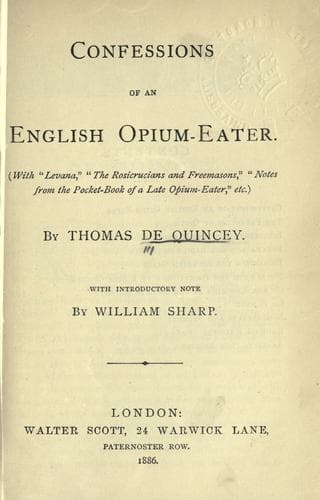
Note Book of an English Opium-EaterDe Quincey, Thomas
Philosophy
Note Book of an English Opium-Eater
De Quincey, Thomas
Opium abuse -- England
is known, and is I am persuaded perfectly conscientious and as impartial
as in such a case it is possible for a high churchman to be. Yet so it is
that there is scarcely one of the notes having any political reference to
the period of 1640-1660, which is not disfigured by unjust prejudices: and
the amount of the moral which the learned editor grounds upon the
documents before him--is this, that the young student is to cherish the
deepest abhorrence and contempt of all who had any share on the
parliamentary side in the 'confusions' of the period from 1640 to 1660:
that is to say of men to whose immortal exertions it was owing that the
very revolution of 1688, which Dr. W. will be the first to applaud, found
us with any such stock of political principles or feelings as could make a
beneficial revolution possible. Where, let me ask, would have been the
willingness of some Tories to construe the flight of James II. into a
virtual act of abdication, or to consider even the most formal act of
abdication binding against the king,-had not the great struggle of
Charles's days gradually substituted in the minds of all parties a
rational veneration of the king's _office_ for the old superstition
in behalf of the king's _person_, which would have protected him from
the effects of any acts however solemnly performed which affected
injuriously either his own interests or the liberties of his people.
Tempora mutantur: _nos et mutamur in illis_. Those whom we find in
fierce opposition to the popular party about 1640 we find still in the
same personal opposition fifty years after, but an opposition resting on
far different principles: insensibly the principles of their antagonists
had reached even them: and a courtier of 1689 was willing to concede more
than a patriot of 1630 would have ventured to ask. Let me not be
understood to mean that true patriotism is at all more shown in supporting
the rights of the people than those of the king: as soon as both are
defined and limited, the last are as indispensable to the integrity of the
constitution--as the first: and popular freedom itself would suffer as
much, though indirectly, from an invasion of Caesar's rights--as by a more
direct attack on itself. But in the 17th century the rights of the people
were as yet _not_ defined: throughout that century they were gradually
defining themselves--and, as happiness to all great practical interests,
defining themselves through a course of fierce and bloody contests. For
the kingly rights are almost inevitably carried too high in ages of
imperfect civilization: and the well-known laws of Henry the Seventh, by
which he either broke or gradually sapped the power of the aristocracy,
had still more extravagantly exalted them. On this account it is just to
look upon democratic or popular politics as identical in the 17th century
with patriotic politics. In later periods, the democrat and the patriot
have sometimes been in direct opposition to each other: at that period
Public-domain text, read in full here on John Shaqi.
Reviews
Reviews
No reviews yet
Be the first to share your thoughts on this work.
Elsewhere in the archive
Join the Discussion
Join the discussion
Sign in to leave a comment or review.
Sign InorCreate an account