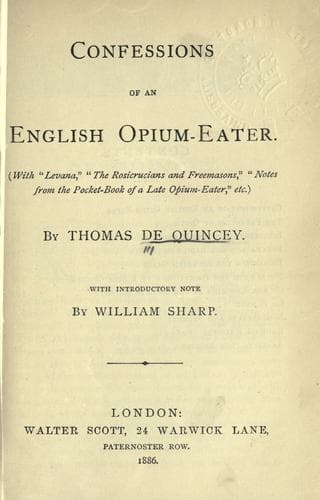
Note Book of an English Opium-EaterDe Quincey, Thomas
Philosophy
Note Book of an English Opium-Eater
De Quincey, Thomas
Opium abuse -- England
they were inevitably in conjunction. All this, however, is in general
overlooked by those who either write English history or comment upon it.
Most writers _of_ or _upon_ English history proceed either upon servile
principles, or upon no principles: and a good _Spirit of English History_,
that is, a history which should abstract the tendencies and main results
[as to laws, manners, and constitution] from every age of English history,
is a work which I hardly hope to see executed. For it would require the
concurrence of some philosophy, with a great deal of impartiality. How
idly do we say, in speaking of the events of our own time which affect our
party feelings,--'We stand too near to these events for an impartial
estimate: we must leave them to the judgment of posterity!' For it is a
fact that of the many books of memoirs written by persons who were not
merely contemporary with the great civil war, but actors and even leaders
in its principal scenes--there is hardly one which does not exhibit a more
impartial picture of that great drama than the histories written at his
day. The historian of Popery does not display half so much zealotry and
passionate prejudice in speaking of the many events which have affected
the power and splendor of the Papal See for the last thirty years, and
under his own eyes, as he does when speaking of a reformer who lived three
centuries ago--of a translator of the Bible into a vernacular tongue who
lived nearly five centuries ago--of an Anti-pope--of a Charlemagne or a
Gregory the Great still further removed from himself. The recent events he
looks upon as accidental and unessential: but in the great enemies, or
great founders of the Romish temporal power, and in the history of their
actions and their motives, he feels that the whole principle of the Romish
cause and its pretensions are at stake. Pretty much under the same feeling
have modern writers written with a rancorous party spirit of the political
struggles in the 17th century: here they fancy that they can detect the
_incunabula_ of the revolutionary spirit: here some have been so
sharpsighted as to read the features of pure jacobinism: and others [2]
have gone so far as to assert that all the atrocities of the French
revolution had their direct parallelisms in acts done or countenanced by
the virtuous and august Senate of England in 1640! Strange distortion of
the understanding which can thus find a brotherly resemblance between two
great historical events, which of all that ever were put on record stand
off from each other in most irreconcilable enmity: the one originating, as
Mr. Coleridge has observed, in excess of principle; the other in the utter
defect of all moral principle whatever; and the progress of each being
answerable to its origin! Yet so it is. And not a memoir-writer of that
age is reprinted in this, but we have a preface from some red-hot Anti-
jacobin warning us with much vapid common-place from the mischiefs and
Public-domain text, read in full here on John Shaqi.
Reviews
Reviews
No reviews yet
Be the first to share your thoughts on this work.
Elsewhere in the archive
Join the Discussion
Join the discussion
Sign in to leave a comment or review.
Sign InorCreate an account