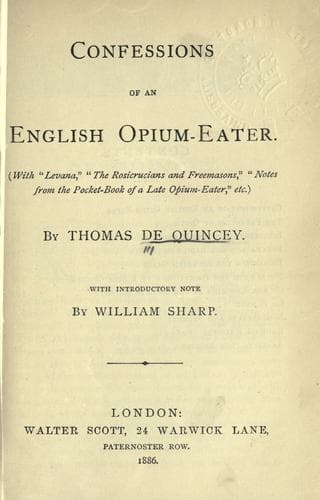
Note Book of an English Opium-EaterDe Quincey, Thomas
Philosophy
Note Book of an English Opium-Eater
De Quincey, Thomas
Opium abuse -- England
eventual anarchy of too rash a spirit of reform as displayed in the French
revolution--_not_ by the example of that French revolution, but by that of
our own in the age of Charles I. The following passage from the
Introduction to Sir William Waller's Vindication published in 1793, may
serve as a fair instance: 'He' (Sir W. Waller) 'was, indeed, at length
sensible of the misery which he had contributed to bring on his country;'
(by the way, it is a suspicious circumstance--that Sir William [3] first
became sensible that his country was miserable, when he became sensible
that he himself was not likely to be again employed; and became fully
convinced of it, when his party lost their ascendancy:) 'he was convinced,
by fatal experience, that anarchy was a bad step towards a perfect
government; that the subversion of every establishment was no safe
foundation for a permanent and regular constitution: he found that
pretences of reform were held up by the designing to dazzle the eyes of
the unwary, &c.; he found in short that reformation, by popular
insurrection, must end in the destruction and cannot tend to the formation
of a regular Government.' After a good deal more of this well-meaning
cant, the Introduction concludes with the following sentence:--the writer
is addressing the reformers of 1793, amongst whom--'both leaders and
followers,' he says, 'may together reflect--that, upon speculative and
visionary reformers,' (_i.e._ those of 1640) 'the severest punishment
which God in his vengeance ever yet inflicted--was to curse them with the
complete gratification of their own inordinate desires.' I quote this
passage--not as containing any thing singular, but for the very reason
that it is _not_ singular: it expresses in fact the universal opinion:
notwithstanding which I am happy to say that it is false. What 'complete
gratification of their own desires' was ever granted to the 'reformers' in
question? On the contrary, it is well known (and no book illustrates that
particular fact so well as Sir William Waller's) that as early as 1647 the
army had too effectually subverted the just relations between itself and
parliament--not to have suggested fearful anticipations to all discerning
patriots of that unhappy issue which did in reality blight their
prospects. And, when I speak of an 'unhappy issue,' I would be understood
only of the immediate issue: for the remote issue was--the revolution of
1688, as I have already asserted. Neither is it true that even the
immediate issue was 'unhappy' to any extent which can justify the ordinary
language in which it is described. Here again is a world of delusions. We
hear of 'anarchy,' of 'confusions,' of 'proscriptions,' of 'bloody and
ferocious tyranny.' All is romance; there was no anarchy; no confusions;
no proscriptions; no tyranny in the sense designed. The sequestrations,
forfeitures, and punishments of all sorts which were inflicted by the
Public-domain text, read in full here on John Shaqi.
Reviews
Reviews
No reviews yet
Be the first to share your thoughts on this work.
Elsewhere in the archive
Join the Discussion
Join the discussion
Sign in to leave a comment or review.
Sign InorCreate an account