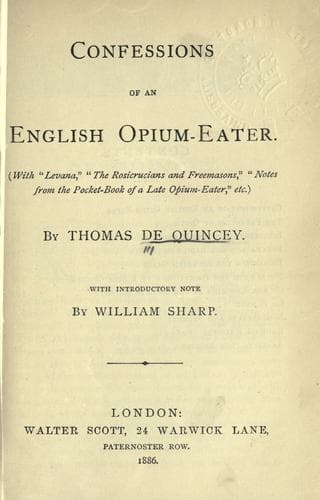
Note Book of an English Opium-EaterDe Quincey, Thomas
Philosophy
Note Book of an English Opium-Eater
De Quincey, Thomas
Opium abuse -- England
conquering party on their antagonists--went on by due course of law; and
the summary justice of courts martial was not resorted to in England:
except for the short term of the two wars, and the brief intermediate
campaign of 1648, the country was in a very tranquil state. Nobody was
punished without an open trial; and all trials proceeded in the regular
course, according to the ancient forms, and in the regular courts of
justice. And as to 'tyranny,' which is meant chiefly of the acts of
Cromwell's government, it should be remembered that the Protectorate
lasted not a quarter of the period in question (1640-1660); a fact which
is constantly forgotten even by very eminent writers, who speak as though
Cromwell had drawn his sword in January 1649--cut off the king's head--
instantly mounted his throne--and continued to play the tyrant for the
whole remaining period of his life (nearly ten years). Secondly, as to the
_kind_ of tyranny which Cromwell exercised, the misconception is
ludicrous: continental writers have a notion, well justified by the
language of English writers, that Cromwell was a ferocious savage who
built his palace of human skulls and desolated his country. Meantime, he
was simply a strong-minded--rough-built Englishman, with a character
thoroughly English, and exceedingly good-natured. Gray valued himself upon
his critical knowledge of English history: yet how thoughtlessly does he
express the abstract of Cromwell's life in the line on the village
Cromwell--'Some Cromwell, guiltless of his country's blood!' How was
Cromwell guilty of his country's blood? What blood did he cause to be
shed? A great deal was shed no doubt in the wars (though less, by the way,
than is imagined): but in those Cromwell was but a servant of the
parliament: and no one will allege that he had any hand in causing a
single war. After he attained the sovereign power, no more domestic wars
arose: and as to a few persons who were executed for plots and
conspiracies against his person, they were condemned upon evidence openly
given and by due course of law. With respect to the general character of
his government, it is evident that in the unsettled and revolutionary
state of things which follows a civil war some critical cases will arise
to demand an occasional 'vigor beyond the law'--such as the Roman
government allowed of in the dictatorial power. But in general, Cromwell's
government was limited by law: and no reign in that century, prior to the
revolution, furnishes fewer instances of attempts to tamper with the laws
--to overrule them--to twist them to private interpretations--or to
dispense with them. As to his major-generals of counties, who figure in
most histories of England as so many _Ali Pachas_ that impaled a few
prisoners every morning before breakfast--or rather as so many ogres that
ate up good Christian men, women and children alive, they were
disagreeable people who were disliked much in the same way as our
Public-domain text, read in full here on John Shaqi.
Reviews
Reviews
No reviews yet
Be the first to share your thoughts on this work.
Elsewhere in the archive
Join the Discussion
Join the discussion
Sign in to leave a comment or review.
Sign InorCreate an account