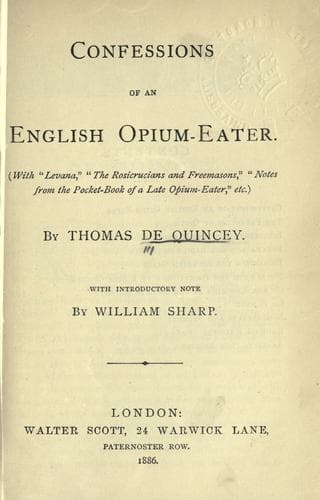
Note Book of an English Opium-EaterDe Quincey, Thomas
Philosophy
Note Book of an English Opium-Eater
De Quincey, Thomas
Opium abuse -- England
commissioners of the income-tax were disliked in the memory of us all; and
heartily they would have laughed at the romantic and bloody masquerade in
which they are made to figure in the English histories. What then was the
'tyranny' of Cromwell's government, which is confessedly complained of
even in those days? The word 'tyranny' was then applied not so much to the
mode in which his power was administered (except by the prejudiced)--as to
its origin. However mercifully a man may reign,--yet, if he have no right
to reign at all, we may in one sense call him a tyrant; his power not
being justly derived, and resting upon an unlawful (_i.e._ a military)
basis. As a usurper, and one who had diverted the current of a grand
national movement to selfish and personal objects, Cromwell was and
will be called a tyrant; but not in the more obvious sense of the word.
Such are the misleading statements which disfigure the History of England
in its most important chapter. They mislead by more than a simple error of
fact: those, which I have noticed last, involve a moral anachronism; for
they convey images of cruelty and barbarism such as could not co-exist
with the national civilization at that time; and whosoever has not
corrected this false picture by an acquaintance with the English
literature of that age, must necessarily image to himself a state of
society as rude and uncultured as that which prevailed during the wars of
York and Lancaster--_i.e._ about two centuries earlier. But those,
with which I introduced this article, are still worse; because they
involve an erroneous view of constitutional history, and a most
comprehensive act of ingratitude: the great men of the Long Parliament
paid a heavy price for their efforts to purchase for their descendants a
barrier to irresponsible power and security from the anarchy of undefined
regal prerogative: in these efforts most of them made shipwreck of their
own tranquillity and peace; that such sacrifices were made unavailingly
(as it must have seemed to themselves), and that few of them lived to see
the 'good old cause' finally triumphant, does not cancel their claims upon
our gratitude--but rather strengthen them by the degree in which it
aggravated the difficulty of bearing such sacrifices with patience. But
whence come these falsifications of history? I believe, from two causes;
first (as I have already said) from the erroneous tone impressed upon the
national history by the irritated spirit of the clergy of the established
church: to the religious zealotry of those times--the church was the
object of especial attack; and its members were naturally exposed to heavy
sufferings: hence their successors are indisposed to find my good in a
cause which could lead to such a result. It is their manifest right to
sympathize with their own order in that day; and in such a case it is
almost their duty to be incapable of an entire impartiality. Meantime they
Public-domain text, read in full here on John Shaqi.
Reviews
Reviews
No reviews yet
Be the first to share your thoughts on this work.
Elsewhere in the archive
Join the Discussion
Join the discussion
Sign in to leave a comment or review.
Sign InorCreate an account