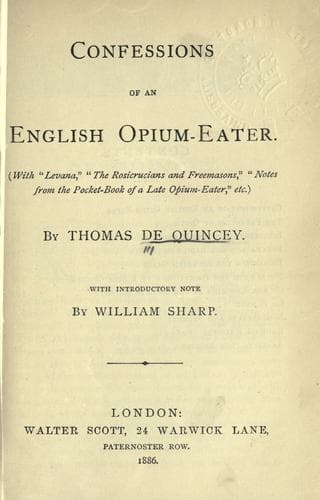
Note Book of an English Opium-EaterDe Quincey, Thomas
Philosophy
Note Book of an English Opium-Eater
De Quincey, Thomas
Opium abuse -- England
[1] This is remarked by her editor and descendant Julius Hutchinson, who
adds some words to this effect--'that _if_ the patriot of that day
were the inventors of the maxim [_The king can do no wrong_], we are
much indebted to them.' The patriots certainly did not invent the maxim,
for they found it already current: but they gave it its new and
constitutional sense. I refer to the book, however, as I do to almost all
books in these notes, from memory; writing most of them in situations
where I have no access to books. By the way, Charles I., who used the
maxim in the most odious sense, furnished the most colorable excuse for
his own execution. He constantly maintained the irresponsibility of his
ministers: but, if that were conceded, it would then follow that the king
must be made responsible in his own person:--and that construction led of
necessity to his trial and death.
[2] Amongst these Mr. D'Israeli in one of the latter volumes of his
'Curiosities of Literature' has dedicated a chapter or so to a formal
proof of this proposition. A reader who is familiar with the history of
that age comes to the chapter with a previous indignation, knowing what
sort of proof he has to expect. This indignation is not likely to be
mitigated by what he will there find. Because some one madman, fool, or
scoundrel makes a monstrous proposal--which dies of itself unsupported,
and is in violent contrast to all the acts and the temper of those times,
--this is to sully the character of the parliament and three-fourths of
the people of England. If this proposal had grown out of the spirit of the
age, that spirit would have produced many more proposals of the same
character and acts corresponding to them. Yet upon this one infamous
proposal, and two or three scandalous anecdotes from the libels of the
day, does the whole onus of Mr. D'Israeli's parallel depend. _Tantamne
rem tam negligenter?_--in the general character of an Englishman I have
a right to complain that so heavy an attack upon the honor of England and
her most virtuous patriots in her most virtuous age should be made with so
much levity: a charge so solemn in its matter should have been prosecuted
with a proportionate solemnity of manner. Mr. D'Israeli refers with just
applause to the opinions of Mr. Coleridge: I wish that he would have
allowed a little more weight to the striking passage in which that
gentleman contrasts the French revolution with the English revolution of
1640-8. However, the general tone of honor and upright principle, which
marks Mr. D'Israeli's' work, encourages me and others to hope that he will
cancel the chapter--and not persist in wounding the honor of a great
people for the sake of a parallelism, which--even if it were true--is a
thousand times too slight and feebly supported to satisfy the most
accommodating reader.
Public-domain text, read in full here on John Shaqi.
Reviews
Reviews
No reviews yet
Be the first to share your thoughts on this work.
Elsewhere in the archive
Join the Discussion
Join the discussion
Sign in to leave a comment or review.
Sign InorCreate an account