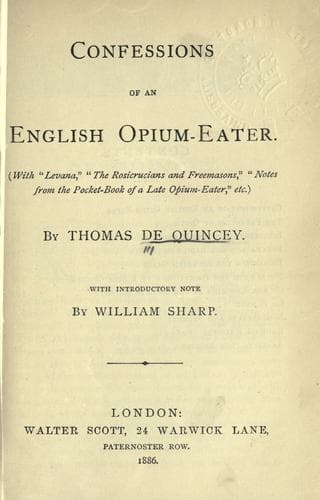
Note Book of an English Opium-EaterDe Quincey, Thomas
Philosophy
Note Book of an English Opium-Eater
De Quincey, Thomas
Opium abuse -- England
This was the only point on which I was disposed
to quarrel with him; for I could not but view it as a greater reproach to
human nature than the slave-trade or any sight of wretchedness that the
sun looks down upon. I often told him so; and that I was at a loss to
guess how a philosopher could allow himself to view it simply as part of
the equipage of civil life, and as reasonably making part of the
establishment and furniture of a great city as police-offices, lamp-
lighting, or newspapers. Waiving however this one instance of something
like compliance with the brutal spirit of the world, on all other subjects
he was eminently unworldly, child-like, simple-minded, and upright. He
would flatter no man: even when addressing nations, it is almost laughable
to see how invariably he prefaces his counsels with such plain truths
uttered in a manner so offensive as must have defeated his purpose if it
had otherwise any chance of being accomplished. For instance, in
addressing America, he begins thus:--'People of America! since your
separation from the mother-country your moral character has degenerated in
the energy of thought and sense; produced by the absence of your
association and intercourse with British officers and merchants: you have
no moral discernment to distinguish between the protective power of
England and the destructive power of France.' And his letter to the Irish
nation opens in this agreeable and conciliatory manner:--'People of
Ireland! I address you as a true philosopher of nature, foreseeing the
perpetual misery your irreflective character and total absence of moral
discernment are preparing for' &c. The second sentence begins thus--'You
are sacrilegiously arresting the arm of your parent kingdom fighting the
cause of man and nature, when the triumph of the fiend of French police-
terror would be your own instant extirpation--.' And the letter closes
thus:--'I see but one awful alternative--that Ireland will be a perpetual
moral volcano, threatening the destruction of the world, if the education
and instruction of thought and sense shall not be able to generate the
faculty of moral discernment among a very numerous class of the
population, who detest the civic calm as sailors the natural calm--and
make civic rights on which they cannot reason a pretext for feuds which
they delight in.' As he spoke freely and boldly to others, so he spoke
loftily of himself: at p. 313, of 'The Harp of Apollo,' on making a
comparison of himself with Socrates (in which he naturally gives the
preference to himself) he styles 'The Harp,' &c., 'this unparalleled work
of human energy.' At p. 315, he calls it 'this stupendous work;' and lower
down on the same page he says--'I was turned out of school at the age of
fifteen for a dunce or blockhead, because I would not stuff into my memory
all the nonsense of erudition and learning; and if future ages should
discover the unparalleled energies of genius in this work, it will prove
Public-domain text, read in full here on John Shaqi.
Reviews
Reviews
No reviews yet
Be the first to share your thoughts on this work.
Elsewhere in the archive
Join the Discussion
Join the discussion
Sign in to leave a comment or review.
Sign InorCreate an account