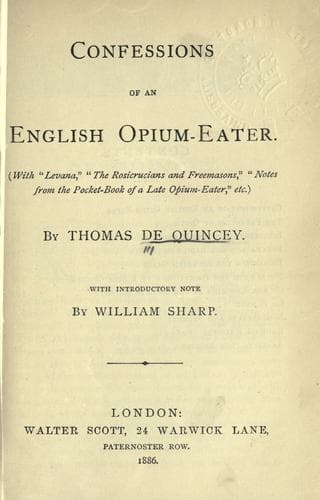
Note Book of an English Opium-EaterDe Quincey, Thomas
Philosophy
Note Book of an English Opium-Eater
De Quincey, Thomas
Opium abuse -- England
my most important doctrine--that the powers of the human mind must be
developed in the education of thought and sense in the study of moral
opinion, not arts and science.' Again, at p. 225 of his Sophiometer, he
says:--'The paramount thought that dwells in my mind incessantly is a
question I put to myself--whether, in the event of my personal dissolution
by death, I have communicated all the discoveries my unique mind possesses
in the great master-science of man and nature.' In the next page he
determines that he _has_, with the exception of one truth,--viz. 'the
latent energy, physical and moral, of human nature as existing in the
British people.' But here he was surely accusing himself without ground:
for to my knowledge he has not failed in any one of his numerous works to
insist upon this theme at least a billion of times. Another instance of
his magnificent self-estimation is--that in the title pages of several of
his works he announces himself as 'John Stewart, the only man of nature
[1] that ever appeared in the world.'
By this time I am afraid the reader begins to suspect that he was crazy:
and certainly, when I consider every thing, he must have been crazy when
the wind was at NNE; for who but Walking Stewart ever dated his books by a
computation drawn--not from the creation, not from the flood, not from
Nabonassar, or _ab urbe condita_, not from the Hegira--but from
themselves, from their own day of publication, as constituting the one
great era in the history of man by the side of which all other eras were
frivolous and impertinent? Thus, in a work of his given to me in 1812 and
probably published in that year, I find him incidentally recording of
himself that he was at that time 'arrived at the age of sixty-three, with
a firm state of health acquired by temperance, and a peace of mind almost
independent of the vices of mankind--because my knowledge of life has
enabled me to place my happiness beyond the reach or contact of other
men's follies and passions, by avoiding all family connections, and all
ambitious pursuits of profit, fame, or power.' On reading this passage I
was anxious to ascertain its date; but this, on turning to the title page,
I found thus mysteriously expressed: 'in the 7000th year of Astronomical
History, and the first day of Intellectual Life or Moral World, from the
era of this work.' Another slight indication of craziness appeared in a
notion which obstinately haunted his mind that all the kings and rulers of
the earth would confederate in every age against his works, and would hunt
them out for extermination as keenly as Herod did the innocents in
Bethlehem. On this consideration, fearing that they might be intercepted
by the long arms of these wicked princes before they could reach that
remote Stewartian man or his precursor to whom they were mainly addressed,
he recommended to all those who might be impressed with a sense of their
importance to bury a copy or copies of each work properly secured from
Public-domain text, read in full here on John Shaqi.
Reviews
Reviews
No reviews yet
Be the first to share your thoughts on this work.
Elsewhere in the archive
Join the Discussion
Join the discussion
Sign in to leave a comment or review.
Sign InorCreate an account