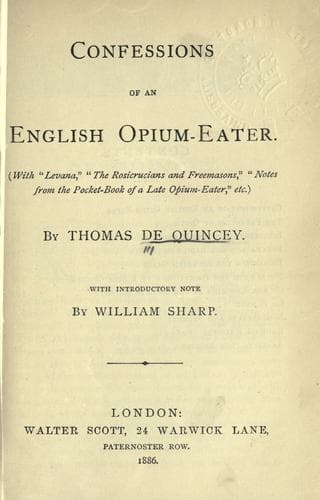
Note Book of an English Opium-EaterDe Quincey, Thomas
Philosophy
Note Book of an English Opium-Eater
De Quincey, Thomas
Opium abuse -- England
should then have a state of Grecian life amongst us in which every man
individually would attain in a moderate degree all the purposes of the
sane understanding,--but in which all the purposes of the sane
understanding would be but moderately attained. What I mean is this:--let
all the objects of the understanding in civil life or in science be
represented by the letters of the alphabet; in Grecian life each man would
separately go through all the letters in a tolerable way; whereas at
present each letter is served by a distinct body of men. Consequently the
Grecian individual is superior to the modern; but the Grecian whole is
inferior: for the whole is made up of the individuals; and the Grecian
individual repeats himself. Whereas in modern life the whole derives its
superiority from the very circumstances which constitute the inferiority
of the parts; for modern life is _cast_ dramatically: and the difference
is as between an army consisting of soldiers who should each individually
be competent to go through the duties of a dragoon--of a hussar--of a
sharp-shooter--of an artillery-man--of a pioneer, &c. and an army on its
present composition, where the very inferiority of the soldier as an
individual--his inferiority in compass and versatility of power and
knowledge--is the very ground from which the army derives its superiority
as a whole, viz. because it is the condition of the possibility of a total
surrender of the individual to one exclusive pursuit. In science
therefore, and (to speak more generally) in the whole evolution of the
human faculties, no less than in Political Economy, the progress of
society brings with it a necessity of sacrificing the ideal of what is
excellent for the individual, to the ideal of what is excellent for the
whole. We need therefore not trouble ourselves (except as a speculative
question) with the comparison of the two states; because, as a practical
question, it is precluded by the overruling tendencies of the age--which
no man could counteract except in his own single case, _i.e._ by refusing
to adapt himself as a part to the whole, and thus foregoing the advantages
of either one state or the other. [1]
FOOTNOTE
Public-domain text, read in full here on John Shaqi.
Reviews
Reviews
No reviews yet
Be the first to share your thoughts on this work.
Elsewhere in the archive
Join the Discussion
Join the discussion
Sign in to leave a comment or review.
Sign InorCreate an account