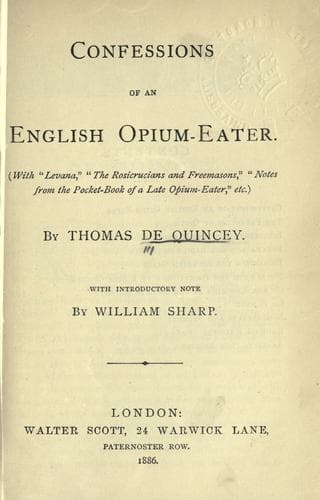
Note Book of an English Opium-EaterDe Quincey, Thomas
Philosophy
Note Book of an English Opium-Eater
De Quincey, Thomas
Opium abuse -- England
[1] The latter part of what is here said coincides, in a way which is
rather remarkable, with a passage in an interesting work of Schiller's
which I have since read, (_on the Aesthetic Education of Men_, in a
series of letters: vid. letter the 6th.) 'With us in order to obtain the
representative _word_ (as it were) of the total species, we must
spell it out by the help of a series of individuals. So that on a survey
of society as it actually exists, one might suppose that the faculties of
the mind do really in actual experience show themselves in as separate a
form, and in as much insulation, as psychology is forced to exhibit them
in its analysis. And thus we see not only individuals, but whole classes
of men, unfolding only one part of the germs which are laid in them by the
hand of nature. In saying this I am fully aware of the advantages which
the human species of modern ages has, when considered as a unity, over the
best of antiquity: but the comparison should begin with the individuals:
and then let me ask where is the modern individual that would have the
presumption to step forward against the Athenian individual--man to man,
and to contend for the prize of human excellence? The polypus nature of
the Grecian republics, in which every individual enjoyed a separate life,
and if it were necessary could become a whole, has now given place to an
artificial watch-work, where many lifeless parts combine to form a
mechanic whole. The state and the church, laws and manners, are now torn
asunder: labor is divided from enjoyment, the means from the end, the
exertion from the reward. Chained for ever to a little individual fraction
of the whole, man himself is moulded into a fraction; and, with the
monotonous whirling of the wheel which he turns everlastingly in his ear,
he never develops the harmony of his being; and, instead of imaging the
totality of human nature, becomes a bare abstract of his business or the
science which he cultivates. The dead letter takes the place of the living
understanding; and a practised memory becomes a surer guide than genius
and sensibility. Doubtless the power of genius, as we all know, will not
fetter itself within the limits of its occupation; but talents of
mediocrity are all exhausted in the monotony of the employment allotted to
them; and that man must have no common head who brings with him the
geniality of his powers unstripped of their freshness by the ungenial
labors of life to the cultivation of the genial.' After insisting at some
length on this wise, Schiller passes to the other side of the
contemplation, and proceeds thus:--'It suited my immediate purpose to
point out the injuries of this condition of the species, without
displaying the compensations by which nature has balanced them. But I will
now readily acknowledge--that, little as this practical condition may suit
the interests of the individual, yet the species could in no other way
have been progressive.
Public-domain text, read in full here on John Shaqi.
Reviews
Reviews
No reviews yet
Be the first to share your thoughts on this work.
Elsewhere in the archive
Join the Discussion
Join the discussion
Sign in to leave a comment or review.
Sign InorCreate an account