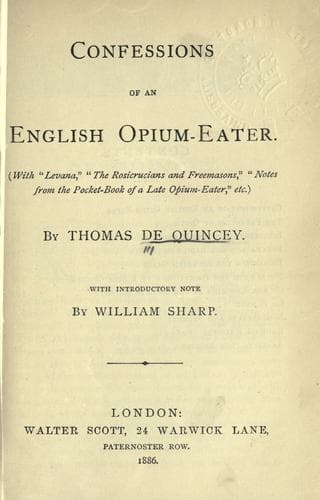
Note Book of an English Opium-EaterDe Quincey, Thomas
Philosophy
Note Book of an English Opium-Eater
De Quincey, Thomas
Opium abuse -- England
[2] Thus Milton, who (in common with his contemporaries) always uses the
word accurately, speaks of Ezekiel 'swallowing his implicit roll of
knowledge'--_i.e._ coming to the knowledge of many truths not separately
and in detail, but by the act of arriving at some one master truth which
involved all the rest.--So again, if any man or government were to
suppress a book, that man or government might justly be reproached as the
implicit destroyer of all the wisdom and virtue that might have been the
remote products of that book.
DRYDEN'S HEXASTICH.
It is a remarkable fact, that the very finest epigram in the English
language happens also to be the worst. _Epigram_ I call it in the
austere Greek sense; which thus far resembled our modern idea of an
epigram, that something pointed and allied to wit was demanded in the
management of the leading thought at its close, but otherwise nothing
tending towards the comic or the ludicrous. The epigram I speak of is the
well-known one of Dryden dedicated to the glorification of Milton. It is
irreproachable as regards its severe brevity. Not one word is there that
could be spared; nor could the wit of man have cast the movement of the
thought into a better mould. There are three couplets. In the first
couplet we are reminded of the fact that this earth had, in three
different stages of its development, given birth to a trinity of
transcendent poets; meaning narrative poets, or, even more narrowly, epic
poets. The duty thrown upon the second couplet is to characterize these
three poets, and to value them against each other, but in such terms as
that, whilst nothing less than the very highest praise should be assigned
to the two elder poets in this trinity--the Greek and the Roman--
nevertheless, by some dexterous artifice, a higher praise than the highest
should suddenly unmask itself, and drop, as it were, like a diadem from
the clouds upon the brows of their English competitor. In the kind of
expectation raised, and in the extreme difficulty of adequately meeting
this expectation, there was pretty much the same challenge offered to
Dryden as was offered, somewhere about the same time, to a British
ambassador when dining with his political antagonists. One of these--the
ambassador of France--had proposed to drink his master, Louis XIV., under
the character of the sun, who dispensed life and light to the whole
political system. To this there was no objection; and immediately, by way
of intercepting any further draughts upon the rest of the solar system,
the Dutch ambassador rose, and proposed the health of their high
mightinesses the Seven United States, as the moon and six [1] planets, who
gave light in the absence of the sun. The two foreign ambassadors,
Monsieur and Mynheer, secretly enjoyed the mortification of their English
brother, who seemed to be thus left in a state of bankruptcy, 'no funds'
being available for retaliation, or so they fancied. But suddenly our
Public-domain text, read in full here on John Shaqi.
Reviews
Reviews
No reviews yet
Be the first to share your thoughts on this work.
Elsewhere in the archive
Join the Discussion
Join the discussion
Sign in to leave a comment or review.
Sign InorCreate an account