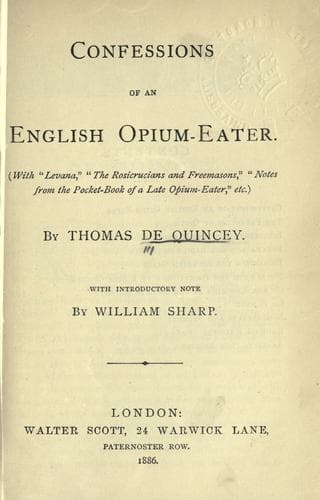
Note Book of an English Opium-EaterDe Quincey, Thomas
Philosophy
Note Book of an English Opium-Eater
De Quincey, Thomas
Opium abuse -- England
British representative toasted _his_ master as Joshua, the son of
Nun, that made the sun and moon stand still. All had seemed lost for
England, when in an instant of time both her antagonists were checkmated.
Dryden assumed something of the same position. He gave away the supreme
jewels in his exchequer; apparently nothing remained behind; all was
exhausted. To Homer he gave A; to Virgil he gave B; and, behold! after
these were given away, there remained nothing at all that would not have
been a secondary praise. But, in a moment of time, by giving A _and_
B to Milton, at one sling of his victorious arm he raised him above Homer
by the whole extent of B, and above Virgil by the whole extent of A. This
felicitous evasion of the embarrassment is accomplished in the second
couplet; and, finally, the third couplet winds up with graceful effect, by
making a _resume_, or recapitulation of the logic concerned in the
distribution of prizes just announced. Nature, he says, had it not in her
power to provide a third prize separate from the first and second; her
resource was, to join the first and second in combination: 'To make a
third, she joined the former two.'
Such is the abstract of this famous epigram; and, judged simply by the
outline and tendency of the thought, it merits all the vast popularity
which it has earned. But in the meantime, it is radically vicious as
regards the filling in of this outline; for the particular quality in
which Homer is accredited with the pre-eminence, viz., _loftiness of
thought_, happens to be a mere variety of expression for that quality,
viz. _majesty_, in which the pre-eminence is awarded to Virgil. Homer
excels Virgil in the very point in which lies Virgil's superiority to
Homer; and that synthesis, by means of which a great triumph is reserved
to Milton, becomes obviously impossible, when it is perceived that the
supposed analytic elements of this synthesis are blank reiterations of
each other.
Exceedingly striking it is, that a thought should have prospered for one
hundred and seventy years, which, on the slightest steadiness of
examination, turns out to be no thought at all, but mere blank vacuity.
There is, however, this justification of the case, that the mould, the set
of channels, into which the metal of the thought is meant to run, really
_has_ the felicity which it appears to have: the form is perfect; and
it is merely in the _matter_, in the accidental filling up of the mould,
that a fault has been committed. Had the Virgilian point of excellence
been _loveliness_ instead of _majesty_, or any word whatever suggesting
the common antithesis of sublimity and beauty; or had it been power on the
one side, matched against grace on the other, the true lurking tendency of
the thought would have been developed, and the sub-conscious purpose of
the epigram would have fulfilled itself to the letter.
Public-domain text, read in full here on John Shaqi.
Reviews
Reviews
No reviews yet
Be the first to share your thoughts on this work.
Elsewhere in the archive
Join the Discussion
Join the discussion
Sign in to leave a comment or review.
Sign InorCreate an account