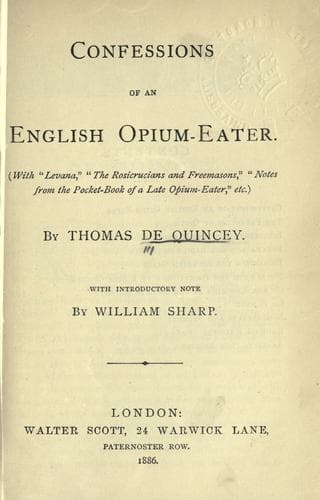
Note Book of an English Opium-EaterDe Quincey, Thomas
Philosophy
Note Book of an English Opium-Eater
De Quincey, Thomas
Opium abuse -- England
_N.B._--It is not meant that _loftiness of thought_ and _majesty_ are
expressions so entirely interchangeable, as that no shades of difference
could be suggested; it is enough that these 'shades' are not substantial
enough, or broad enough, to support the weight of opposition which the
epigram assigns to them. _Grace_ and _elegance_, for instance, are far
from being in all relations synonymous; but they are so to the full extent
of any purposes concerned in this epigram. Nevertheless, it is probable
enough that Dryden had moving in his thoughts a relation of the word
_majesty_, which, if developed, would have done justice to his meaning. It
was, perhaps, the decorum and sustained dignity of the _composition_--the
workmanship apart from the native grandeur of the materials--the majestic
style of the artistic treatment as distinguished from the original
creative power--which Dryden, the translator of the Roman poet, familiar
therefore with his weakness and with his strength, meant in this place to
predicate as characteristically observable in Virgil.
FOOTNOTE
[1] '_Six planets_;'--No more had then been discovered.
POPE'S RETORT UPON ADDISON.
There is nothing extraordinary, or that could merit a special notice, in a
simple case of oversight, or in a blunder, though emanating from the
greatest of poets. But such a case challenges and forces our attention,
when we know that the particular passage in which it occurs was wrought
and burnished with excessive pains; or (which in this case is also known)
when that particular passage is pushed into singular prominence as having
obtained a singular success. In no part of his poetic mission did Pope so
fascinate the gaze of his contemporaries as in his functions of satirist;
which functions, in his latter years, absorbed all other functions. And
one reason, I believe, why it was that the interest about Pope decayed so
rapidly after his death (an accident somewhere noticed by Wordsworth),
must be sought in the fact, that the most stinging of his personal
allusions, by which he had given salt to his later writings, were
continually losing their edge, and sometimes their intelligibility, as
Pope's own contemporary generation was dying off. Pope alleges it as a
palliation of his satiric malice, that it had been forced from him in the
way of retaliation; forgetting that such a plea wilfully abjures the
grandest justification of a satirist, viz., the deliberate assumption of
the character as something corresponding to the prophet's mission amongst
the Hebrews. It is no longer the _facit indignatio versum_. Pope's
satire, where even it was most effective, was personal and vindictive, and
upon that argument alone could not he philosophic. Foremost in the order
of his fulminations stood, and yet stands, the bloody castigation by
which, according to his own pretence, he warned and menaced (but by which,
in simple truth, he executed judgment upon) his false friend, Addison.
Public-domain text, read in full here on John Shaqi.
Reviews
Reviews
No reviews yet
Be the first to share your thoughts on this work.
Elsewhere in the archive
Join the Discussion
Join the discussion
Sign in to leave a comment or review.
Sign InorCreate an account