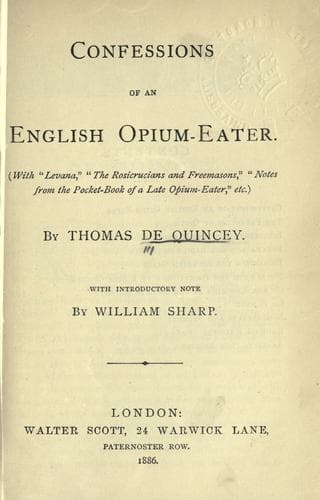
Note Book of an English Opium-EaterDe Quincey, Thomas
Philosophy
Note Book of an English Opium-Eater
De Quincey, Thomas
Opium abuse -- England
To say that this drew vast rounds of applause upon its author, and
frightened its object into deep silence for the rest of his life, like the
_Quos ego_ of angry Neptune, sufficiently argues that the verses must
have ploughed as deeply as the Russian knout. Vitriol could not scorch
more fiercely. And yet the whole passage rests upon a blunder; and the
blunder is so broad and palpable, that it implies instant forgetfulness
both in the writer and the reader. The idea which furnishes the basis of
the passage is this: that the conduct ascribed to Addison is in its own
nature so despicable, as to extort laughter by its primary impulse; but
that this laughter changes into weeping, when we come to understand that
the person concerned in this delinquency is Addison. The change, the
transfiguration, in our mood of contemplating the offence, is charged upon
the discovery which we are supposed to make as to the person of the
offender; that which by its baseness had been simply comic when imputed to
some corresponding author, passes into a tragic _coup-de-theatre_,
when it is suddenly traced back to a man of original genius. The whole,
therefore, of this effect is made to depend upon the sudden scenical
transition from a supposed petty criminal to one of high distinction. And,
meantime, no such stage effect had been possible, since the knowledge that
a man of genius was the offender had been what we started with from the
beginning. 'Our laughter is changed to tears,' says Pope, 'as soon as we
discover that the base act had a noble author.' And, behold! the initial
feature in the whole description of the case is, that the libeller was one
whom 'true genius fired:'
'Peace to all such! But were there one whose mind
True genius fires,' &c.
Before the offence is described, the perpetrator is already characterized
as a man of genius: and, _in spite of that knowledge_, we laugh. But
suddenly our mood changes, and we weep, but why? I beseech you. Simply
because we have ascertained the author to be a man of genius.
'Who would not laugh, if such a man there be?
Who would not weep, if Atticus were he?'
The sole reason for weeping is something that we knew already before we
began to laugh.
Public-domain text, read in full here on John Shaqi.
Reviews
Reviews
No reviews yet
Be the first to share your thoughts on this work.
Elsewhere in the archive
Join the Discussion
Join the discussion
Sign in to leave a comment or review.
Sign InorCreate an account