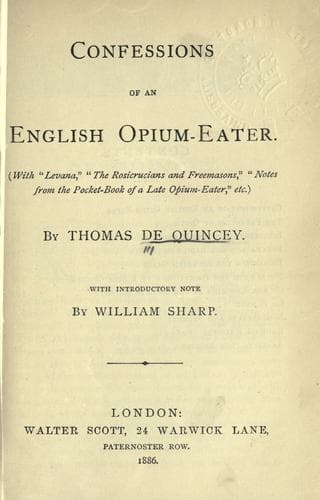
Note Book of an English Opium-EaterDe Quincey, Thomas
Philosophy
Note Book of an English Opium-Eater
De Quincey, Thomas
Opium abuse -- England
It would not be right in logic, in fact, it would be a mis-classification,
if I should cite as at all belonging to the same group several passages in
Milton that come very near to Irish bulls, by virtue of distorted
language. One reason against such a classification would lie precisely in
that fact--viz., that the assimilation to the category of bulls lurks in
the verbal expression, and not (as in Pope's case) amongst the conditions
of the thought. And a second reason would lie in the strange circumstance,
that Milton had not fallen into this snare of diction through any
carelessness or oversight, but with his eyes wide open, deliberately
avowing his error as a special elegance; repeating it; and well aware of
splendid Grecian authority for his error, if anybody should be bold enough
to call it an error. Every reader must be aware of the case--
'Adam the goodliest man of men since born
His sons; the fairest of her daughters Eve'--
which makes Adam one of his own sons, Eve one of her own daughters. This,
however, is authorized by Grecian usage in the severest writers. Neither
can it be alleged that these might be bold poetic expressions, harmonizing
with the Grecian idiom; for Poppo has illustrated this singular form of
expression in a prose-writer, as philosophic and austere as Thucydides; a
form which (as it offends against logic) must offend equally in all
languages. Some beauty must have been described in the idiom, such as
atoned for its solecism: for Milton recurs to the same idiom, and under
the same entire freedom of choice, elsewhere; particularly in this
instance, which has not been pointed out: 'And never,' says Satan to the
abhorred phantoms of Sin and Death, when crossing his path,
'And never saw till now
Sight more detestable than him and thee.'
Now, therefore, it seems, he _had_ seen a sight more detestable than
this very sight. He now looked upon something more hateful than X Y Z.
What was it? It was X Y Z.
Public-domain text, read in full here on John Shaqi.
Reviews
Reviews
No reviews yet
Be the first to share your thoughts on this work.
Elsewhere in the archive
Join the Discussion
Join the discussion
Sign in to leave a comment or review.
Sign InorCreate an account