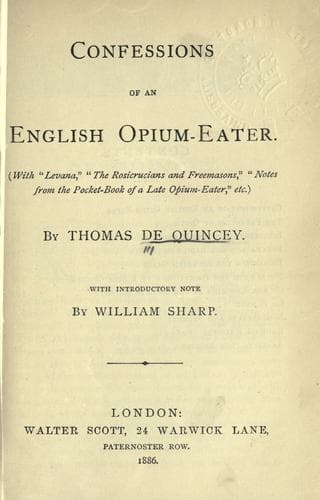
Note Book of an English Opium-EaterDe Quincey, Thomas
Philosophy
Note Book of an English Opium-Eater
De Quincey, Thomas
Opium abuse -- England
But the authority of Milton, backed by that of insolent Greece, would
prove an overmatch for the logic of centuries. And I withdraw, therefore,
from the rash attempt to quarrel with this sort of bull, involving itself
in the verbal expression. But the following, which lies rooted in the mere
facts and incidents, is certainly the most extraordinary _practical_
bull [1] that all literature can furnish. And a stranger thing, perhaps,
than the oversight itself lies in this--that not any critic throughout
Europe, two only excepted, but has failed to detect a blunder so
memorable. All the rampant audacity of Bentley--'slashing Bentley'--all
the jealous malignity of Dr. Johnson--who hated Milton without disguise as
a republican, but secretly and under a mask _would_ at any rate have
hated him from jealousy of his scholarship--had not availed to sharpen
these practised and these interested eyes into the detection of an
oversight which argues a sudden Lethean forgetfulness on the part of
Milton; and in many generations of readers, however alive and awake with
malice, a corresponding forgetfulness not less astonishing. Two readers
only I have ever heard of that escaped this lethargic inattention; one of
which two is myself; and I ascribe my success partly to good luck, but
partly to some merit on my own part in having cultivated a habit of
systematically accurate reading. If I read at all, I make it a duty to
read truly and faithfully. I profess allegiance for the time to the man
whom I undertake to study; and I am as loyal to all the engagements
involved in such a contract, as if I had come under a _sacramentum
militare_. So it was that, whilst yet a boy, I came to perceive, with a
wonder not yet exhausted, that unaccountable blunder which Milton has
committed in the main narrative on which the epic fable of the 'Paradise
Lost' turns as its hinges. And many a year afterwards I found that Paul
Richter, whose vigilance nothing escaped, who carried with him through
life 'the eye of the hawk, and the fire therein,' had not failed to make
the same discovery. It is this: The archangel Satan has designs upon man;
he meditates his ruin; and it is known that he does. Specially to
counteract these designs, and for no other purpose whatever, a choir of
angelic police is stationed at the gates of Paradise, having (I repeat)
one sole commission, viz., to keep watch and ward over the threatened
safety of the newly created human pair. Even at the very first this duty
is neglected so thoroughly, that Satan gains access without challenge or
suspicion. That is awful: for, ask yourself, reader, how a constable or an
inspector of police would be received who had been stationed at No. 6, on
a secret information, and spent the night in making love at No. 15.
Through the regular surveillance at the gates, Satan passes without
objection; and he is first of all detected by a purely accidental
collision during the rounds of the junior angels. The result of this
Public-domain text, read in full here on John Shaqi.
Reviews
Reviews
No reviews yet
Be the first to share your thoughts on this work.
Elsewhere in the archive
Join the Discussion
Join the discussion
Sign in to leave a comment or review.
Sign InorCreate an account