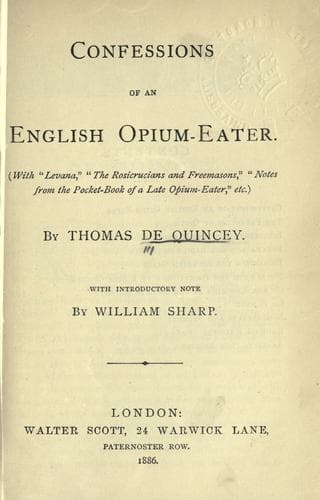
Note Book of an English Opium-EaterDe Quincey, Thomas
Philosophy
Note Book of an English Opium-Eater
De Quincey, Thomas
Opium abuse -- England
Now, on the other hand, in geology and cosmology, the case is stronger.
_Here_ there is no opening for a compliance even with a _language_ that is
erroneous; for no language at all is current upon subjects that have never
engaged the popular attention. _Here_, where there is no such stream of
apparent phenomena running counter (as in astronomy there is) to the real
phenomena, neither is there any popular language opposed to the
scientific. The whole are abtruse speculations, even as regards their
objects, nor dreamed of as possibilities, either in their true aspects or
their false aspects, till modern times. The Scriptures, therefore, nowhere
allude to such sciences, either as taking the shape of histories, applied
to processes current and in movement, or as taking the shape of theories
applied to processes past and accomplished. The Mosaic cosmogony, indeed,
gives the succession of natural births; and probably the general outline
of such a succession will be more and more confirmed as geology advances.
But as to the time, the duration, of this successive evolution, it is the
idlest of notions that the Scriptures either have, or could have,
condescended to human curiosity upon so awful a prologue to the drama of
this world. Genesis would no more have indulged so mean a passion with
respect to the mysterious inauguration of the world, than the Apocalypse
with respect to its mysterious close. 'Yet the six _days_ of Moses!' Days!
But is it possible that human folly should go the length of understanding
by the Mosaical _day_, the mysterious _day_ of that awful agency which
moulded the heavens and the heavenly host, no more than the ordinary
_nychthemeron_ or cycle of twenty-four hours? The period implied in a
_day_, when used in relation to the inaugural manifestation of
creative power in that vast drama which introduces God to man in the
character of a demiurgus or creator of the world, indicated one stage
amongst six; involving probably many millions of years. The silliest of
nurses, in her nursery babble, could hardly suppose that the mighty
process began on a Monday morning, and ended on Saturday night. If we are
seriously to study the value and scriptural acceptation of scriptural
words and phrases, I presume that our first business will be to collate
the use of these words in one part of Scripture, with their use in other
parts, holding the same spiritual relations. The creation, for instance,
does not belong to the earthly or merely historical records, but to the
spiritual records of the Bible; to the same category, therefore, as the
prophetic sections of the Bible. Now, in those, and in the Psalms, how do
we understand the word _day_? Is any man so little versed in biblical
language as not to know, that (except in the merely historical parts of
the Jewish records) every section of time has a secret and separate
acceptation in the Scriptures? Does an aeon, though a Grecian word, bear
scripturally (either in Daniel or in St.
Public-domain text, read in full here on John Shaqi.
Reviews
Reviews
No reviews yet
Be the first to share your thoughts on this work.
Join the Discussion
Join the discussion
Sign in to leave a comment or review.
Sign InorCreate an account