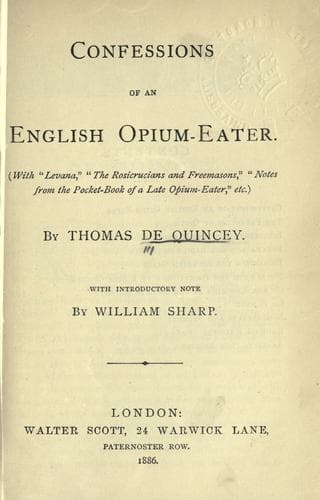
Note Book of an English Opium-EaterDe Quincey, Thomas
Philosophy
Note Book of an English Opium-Eater
De Quincey, Thomas
Opium abuse -- England
John) any sense known to Grecian
ears? Do the seventy _weeks_ of the prophet mean weeks in the sense
of human calendars? Already the Psalms (xc.), already St. Peter (2d
Epist.), warn us of a peculiar sense attached to the word _day_ in
divine ears. And who of the innumerable interpreters understands the
twelve hundred and sixty days in Daniel, or his two thousand and odd days,
to mean, by possibility, periods of twenty-four hours? Surely the theme of
Moses was as mystical, and as much entitled to the benefit of mystical
language, as that of the prophets.
The sum of this matter is this:--God, by a Hebrew prophet, is sublimely
described as _the Revealer_; and, in variation of his own expression,
the same prophet describes him as the Being 'that knoweth the darkness.'
Under no idea can the relations of God to man be more grandly expressed.
But of what is he the revealer? Not surely of those things which he has
enabled man to reveal for himself, but of those things which, were it not
through special light from heaven, must eternally remain sealed up in
inaccessible darkness. On this principle we should all laugh at a revealed
cookery. But essentially the same ridicule, not more, and not less,
applies to a revealed astronomy, or a revealed geology. As a fact, there
_is_ no such astronomy or geology: as a possibility, by the _a priori_
argument which I have used (viz., that a revelation on such fields would
counteract _other_ machineries of providence), there _can_ be no such
astronomy or geology in the Bible. Consequently there _is_ none.
Consequently there can be no schism or feud upon _these_ subjects between
the Bible and the philosophies outside.
SCHLOSSER'S LITERARY HISTORY OF THE EIGHTEENTH CENTURY.
In the person of this Mr. Schlosser is exemplified a common abuse, not
confined to literature. An artist from the Italian opera of London and
Paris, making a professional excursion to our provinces, is received
according to the tariff of the metropolis; no one being bold enough to
dispute decisions coming down from the courts above. In that particular
case there is seldom any reason to complain--since really out of Germany
and Italy there is no city, if you except Paris and London, possessing
_materials_, in that field of art, for the composition of an audience
large enough to act as a court of revision. It would be presumption in the
provincial audience, so slightly trained to good music and dancing, if it
should affect to reverse a judgment ratified in the supreme capital. The
result, therefore, is practically just, if the original verdict was just;
what was right from the first cannot be made wrong by iteration. Yet, even
in such a case, there is something not satisfactory to a delicate sense of
equity; for the artist returns from the tour as if from some new and
independent triumph, whereas, all is but the reverberation of an old one;
it seems a new access of sunlight, whereas it is but a reflex illumination
from satellites.
Public-domain text, read in full here on John Shaqi.
Reviews
Reviews
No reviews yet
Be the first to share your thoughts on this work.
Join the Discussion
Join the discussion
Sign in to leave a comment or review.
Sign InorCreate an account