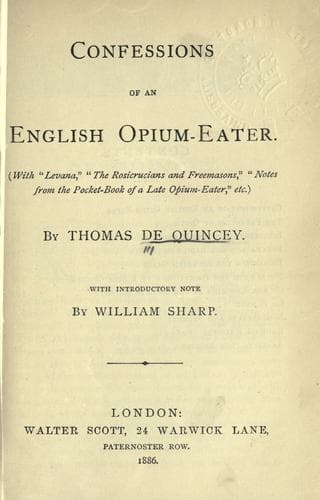
Note Book of an English Opium-EaterDe Quincey, Thomas
Philosophy
Note Book of an English Opium-Eater
De Quincey, Thomas
Opium abuse -- England
In literature the corresponding case is worse. An author, passing by means
of translation before a foreign people, ought _de jure_ to find himself
before a new tribunal; but _de facto_, he does not. Like the opera artist,
but not with the same propriety, he comes before a court that never
interferes to disturb a judgment, but only to re-affirm it. And he returns
to his native country, quartering in his armorial bearings these new
trophies, as though won by new trials, when, in fact, they are due to
servile ratifications of old ones. When Sue, or Balzac, Hugo, or George
Sand, comes before an English audience--the opportunity is invariably lost
for estimating them at a new angle of sight. All who dislike them lay them
aside--whilst those only apply themselves seriously to their study, who
are predisposed to the particular key of feeling, through which originally
these authors had prospered. And thus a new set of judges, that might
usefully have modified the narrow views of the old ones, fall by mere
_inertia_ into the humble character of echoes and sounding-boards to swell
the uproar of the original mob.
In this way is thrown away the opportunity, not only of applying
corrections to false national tastes, but oftentimes even to the unfair
accidents of _luck_ that befall books. For it is well known to all
who watch literature with vigilance, that books and authors have their
fortunes, which travel upon a far different scale of proportions from
those that measure their merits. Not even the caprice or the folly of the
reading public is required to account for this. Very often, indeed, the
whole difference between an extensive circulation for one book, and none
at all for another of about equal merit, belongs to no particular
blindness in men, but to the simple fact, that the one _has_, whilst
the other has _not_, been brought effectually under the eyes of the
public. By far the greater part of books are lost, not because they are
rejected, but because they are never introduced. In any proper sense of
the word, very few books are published. Technically they are published;
which means, that for six or ten times they are _advertised_, but they are
not made known to _attentive_ ears, or to ears _prepared_ for attention.
And amongst the causes which account for this difference in the fortune of
books, although there are many, we may reckon, as foremost, _personal_
accidents of position in the authors. For instance, with us in England it
will do a bad book no _ultimate_ service, that it is written by a lord, or
a bishop, or a privy counsellor, or a member of Parliament--though,
undoubtedly, it will do an _instant_ service--it will sell an edition or
so. This being the case, it being certain that no rank will reprieve a bad
writer from _final_ condemnation, the sycophantic glorifier of the public
fancies his idol justified; but not so. A bad book, it is true, will not
be saved by advantages of position in the author; but a book moderately
Public-domain text, read in full here on John Shaqi.
Reviews
Reviews
No reviews yet
Be the first to share your thoughts on this work.
Join the Discussion
Join the discussion
Sign in to leave a comment or review.
Sign InorCreate an account