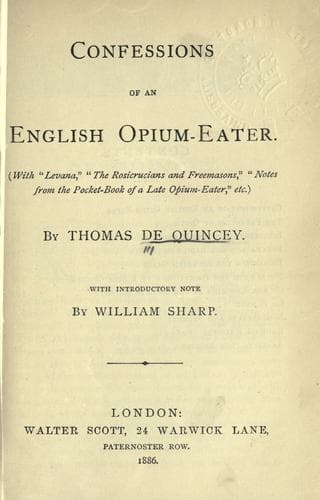
Note Book of an English Opium-EaterDe Quincey, Thomas
Philosophy
Note Book of an English Opium-Eater
De Quincey, Thomas
Opium abuse -- England
Meantime, I repeat, that to disparage any thing whatever, or to turn the
eye upon blemishes, is no part of my present purpose. Nor could it be:
since the one sole section of the Greek literature, as to which I profess
myself an enthusiast, happens to be the tragic drama; and here, only, I
myself am liable to be challenged as an idolater. As regards the Antigone
in particular, so profoundly do I feel the impassioned beauty of her
situation in connection with her character, that long ago, in a work of my
own (yet unpublished), having occasion (by way of overture introducing one
of the sections) to cite before the reader's eye the chief pomps of the
Grecian theatre, after invoking 'the magnificent witch' Medea, I call up
Antigone to this shadowy stage by the apostrophe, Holy heathen, daughter
of God, before God was known, [3] flower from Paradise after Paradise was
closed; that quitting all things for which flesh languishes, safety and
honor, a palace and a home, didst make thyself a houseless pariah, lest
the poor pariah king, thy outcast father, should want a hand to lead him
in his darkness, or a voice to whisper comfort in his misery; angel, that
badst depart for ever the glories of thy own bridal day, lest he that had
shared thy nursery in childhood, should want the honors of a funeral;
idolatrous, yet Christian Lady, that in the spirit of martyrdom trodst
alone the yawning billows of the grave, flying from earthly hopes, lest
everlasting despair should settle upon the grave of thy brother,' &c. In
fact, though all the groupings, and what I would call permanent attitudes
of the Grecian stage, are majestic, there is none that, to my mind, towers
into such affecting grandeur, as this final revelation, through Antigone
herself, and through her own dreadful death, of the tremendous wo that
destiny had suspended over her house. If therefore my business had been
chiefly with the individual drama, I should have found little room for any
sentiment but that of profound admiration. But my present business is
different: it concerns the Greek drama generally, and the attempt to
revive it; and its object is to elucidate, rather than to praise or to
blame. To explain this better, I will describe two things:--1st, The sort
of audience that I suppose myself to be addressing; and, 2dly, As growing
out of _that_, the particular quality of the explanations which I wish to
make.
Public-domain text, read in full here on John Shaqi.
Reviews
Reviews
No reviews yet
Be the first to share your thoughts on this work.
Elsewhere in the archive
Join the Discussion
Join the discussion
Sign in to leave a comment or review.
Sign InorCreate an account