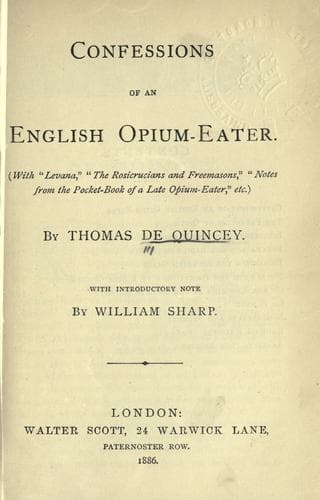
Note Book of an English Opium-EaterDe Quincey, Thomas
Philosophy
Note Book of an English Opium-Eater
De Quincey, Thomas
Opium abuse -- England
1st, As to the audience: in order to excuse the tone (which occasionally I
may be obliged to assume) of one speaking as from a station of knowledge,
to others having no knowledge, I beg it to be understood, that I take that
station deliberately, on no conceit of superiority to my readers, but as a
companion adapting my services to the wants of those who need them. I am
not addressing those already familiar with the Greek drama, but those who
frankly confess, and (according to their conjectural appreciation of it)
who regret their non-familiarity with that drama. It is a thing well known
to publishers, through remarkable results, and is now showing itself on a
scale continually widening, that a new literary public has arisen, very
different from any which existed at the beginning of this century. The
aristocracy of the land have always been, in a moderate degree, literary;
less, however, in connection with the _current_ literature, than with
literature generally--past as well as present. And this is a tendency
naturally favored and strengthened in _them_, by the fine collections
of books, carried forward through successive generations, which are so
often found as a sort of hereditary foundation in the country mansions of
our nobility. But a class of readers, prodigiously more extensive, has
formed itself within the commercial orders of our great cities and
manufacturing districts. These orders range through a large scale. The
highest classes amongst them were always literary. But the interest of
literature has now swept downwards through a vast compass of descents: and
this large body, though the busiest in the nation, yet, by having under
their undisturbed command such leisure time as they have _at all_ under
their command, are eventually able to read more than those even who
seem to have nothing else but leisure. In justice, however, to the
nobility of our land, it should be remembered, that their stations in
society, and their wealth, their territorial duties, and their various
public duties in London, as at court, at public meetings, in parliament,
&c., bring crowded claims upon their time; whilst even sacrifices of time
to the graceful courtesies of life, are in reference to _their_ stations,
a sort of secondary duties. These allowances made, it still remains true
that the busier classes are the main reading classes; whilst from their
immense numbers, they are becoming effectually the body that will more and
more impress upon the moving literature its main impulse and direction.
One other feature of difference there is amongst this commercial class of
readers: amongst the aristocracy all are thoroughly educated, excepting
those who go at an early age into the army; of the commercial body, none
receive an elaborate, and what is meant by a liberal education, except
those standing by their connections in the richest classes. Thus it
happens that, amongst those who have not inherited but achieved their
Public-domain text, read in full here on John Shaqi.
Reviews
Reviews
No reviews yet
Be the first to share your thoughts on this work.
Elsewhere in the archive
Join the Discussion
Join the discussion
Sign in to leave a comment or review.
Sign InorCreate an account