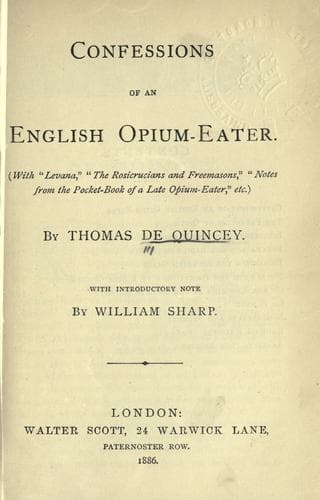
Note Book of an English Opium-EaterDe Quincey, Thomas
Philosophy
Note Book of an English Opium-Eater
De Quincey, Thomas
Opium abuse -- England
stations, many men of fine and powerful understandings, accomplished in
manners, and admirably informed, not having had the benefits when young of
a regular classical education, find (upon any accident bringing up such
subjects) a deficiency which they do not find on other subjects. They are
too honorable to undervalue advantages, which they feel to be
considerable, simply because they were denied to themselves. They regret
their loss. And yet it seems hardly worth while, on a simple prospect of
contingencies that may never be realized, to undertake an entirely new
course of study for redressing this loss. But they would be glad to avail
themselves of any useful information not exacting study. These are the
persons, this is the class, to which I address my remarks on the
'Antigone;' and out of _their_ particular situation, suggesting upon all
elevated subjects a corresponding tone of liberal curiosity, will arise
the particular nature and direction of these remarks.
Accordingly, I presume, secondly, that this curiosity will take the
following course:--these persons will naturally wish to know, at starting,
what there is _differentially_ interesting in a Grecian tragedy, as
contrasted with one of Shakspeare's or of Schiller's: in what respect, and
by what agencies, a Greek tragedy affects us, or is meant to affect us,
otherwise than as _they_ do; and how far the Antigone of Sophocles was
judiciously chosen as the particular medium for conveying to British minds
a first impression, and a representative impression, of Greek tragedy. So
far, in relation to the ends proposed, and the means selected. Finally,
these persons will be curious to know the issue of such an experiment. Let
the purposes and the means have been bad or good, what was the actual
success? And not merely success, in the sense of the momentary acceptance
by half a dozen audiences, whom the mere decencies of justice must have
compelled to acknowledge the manager's trouble and expense on their
behalf; but what was the degree of satisfaction felt by students of the
Athenian [4] tragedy, in relation to their long-cherished ideal? Did the
representation succeed in realizing, for a moment, the awful pageant of
the Athenian stage? Did Tragedy, in Milton's immortal expression,
------come sweeping by
In sceptred pall?
Or was the whole, though successful in relation to the thing attempted, a
failure in relation to what ought to have been attempted? Such are the
questions to be answered.
* * * * *
Public-domain text, read in full here on John Shaqi.
Reviews
Reviews
No reviews yet
Be the first to share your thoughts on this work.
Elsewhere in the archive
Join the Discussion
Join the discussion
Sign in to leave a comment or review.
Sign InorCreate an account