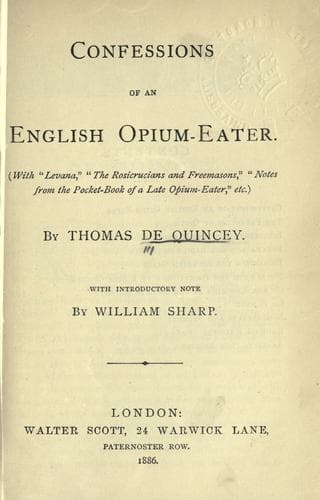
Note Book of an English Opium-EaterDe Quincey, Thomas
Philosophy
Note Book of an English Opium-Eater
De Quincey, Thomas
Opium abuse -- England
The first elementary idea of a Greek tragedy, is to be sought in a serious
Italian opera. The Greek dialogue is represented by the recitative, and
the tumultuous lyrical parts assigned chiefly, though not exclusively, to
the chorus on the Greek stage, are represented by the impassioned airs,
duos, trios, choruses, &c. on the Italian. And there, at the very outset,
occurs a question which lies at the threshold of a Fine Art,--that is of
_any_ Fine Art: for had the views of Addison upon the Italian opera had
the least foundation in truth, there could have been no room or opening
for any mode of imitation except such as belongs to a _mechanic_ art.
The reason for at all connecting Addison with this case is, that _he_
chiefly was the person occupied in assailing the Italian opera; and this
hostility arose, probably, in his want of sensibility to good (that is, to
Italian) music. But whatever might be his motive for the hostility, the
single argument by which he supported it was this,--that a hero ought not
to sing upon the stage, because no hero known to history ever summoned a
garrison in a song, or changed a battery in a semichorus. In this argument
lies an ignorance of the very first principle concern in _every_ Fine
Art. In all alike, more or less directly, the object is to reproduce in
mind some great effect, through the agency of _idem in alio_. The
_idem_, the same impression, is to be restored; but _in alio_, in a
different material,--by means of some different instrument. For instance,
on the Roman stage there was an art, now entirely lost, of narrating, and,
in part of dramatically representing an impassioned tale, by means of
dancing, of musical accompaniment in the orchestra, and of elaborate
pantomime in the performer. _Saltavit Hypermnestram_, he danced (that is,
he represented by dancing and pantomime the story of) Hypermnestra. Now,
suppose a man to object, that young ladies, when saving their youthful
husbands at midnight from assassination, could not be capable of waltzing
or quadrilling, how wide is this of the whole problem! This is still
seeking for the _mechanic_ imitation, some imitation founded in the very
fact; whereas the object is to seek the imitation in the sameness of the
impression drawn from a different, or even from an impossible fact. If a
man, taking a hint from the Roman 'Saltatio' (_saltavit Andromachen_),
should say that he would 'whistle Waterloo,' that is, by whistling
connected with pantomime, would express the passion and the changes of
Waterloo, it would be monstrous to refuse him his postulate on the
pretence that 'people did not whistle at Waterloo.' Precisely so: neither
are most people made of marble, but of a material as different as can well
be imagined, viz. of elastic flesh, with warm blood coursing along its
tubes; and yet, for all _that_, a sculptor will draw tears from you, by
exhibiting, in pure statuary marble, on a sepulchral monument, two young
Public-domain text, read in full here on John Shaqi.
Reviews
Reviews
No reviews yet
Be the first to share your thoughts on this work.
Elsewhere in the archive
Join the Discussion
Join the discussion
Sign in to leave a comment or review.
Sign InorCreate an account