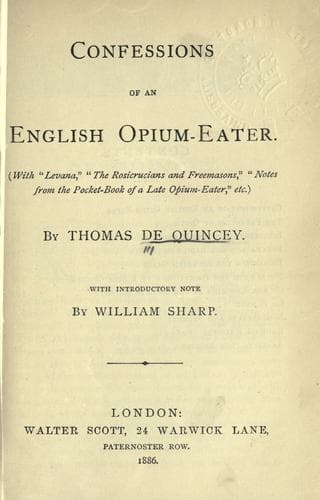
Note Book of an English Opium-EaterDe Quincey, Thomas
Philosophy
Note Book of an English Opium-Eater
De Quincey, Thomas
Opium abuse -- England
children with their little heads on a pillow, sleeping in each other's
arms; whereas, if he had presented them in wax-work, which yet is far more
like to flesh, you would have felt little more pathos in the scene than if
they had been shown baked in gilt gingerbread. He has expressed the
_idem_, the identical thing expressed in the real children; the sleep that
masks death, the rest, the peace, the purity, the innocence; but _in
alio_, in a substance the most different; rigid, non-elastic, and as
unlike to flesh, if tried by touch, or eye, or by experience of life, as
can well be imagined. So of the whistling. It is the very worst objection
in the world to say, that the strife of Waterloo did not reveal itself
through whistling: undoubtedly it did not; but that is the very ground of
the man's art. He will reproduce the fury and the movement as to the only
point which concerns you, viz. the effect, upon your own sympathies,
through a language that seems without any relation to it: he will set
before you what _was_ at Waterloo through that which was _not_ at
Waterloo. Whereas any direct factual imitation, resting upon painted
figures drest up in regimentals, and worked by watchwork through the whole
movements of the battle, would have been no art whatsoever in the sense of
a Fine Art, but a base _mechanic_ mimicry.
This principle of the _idem in alio_, so widely diffused through all
the higher revelations of art, it is peculiarly requisite to bear in mind
when looking at Grecian tragedy, because no form of human composition
employs it in so much complexity. How confounding it would have been to
Addison, if somebody had told him, that, substantially, he had himself
committed the offence (as he fancied it) which he charged so bitterly upon
the Italian opera; and that, if the opera had gone farther upon that road
than himself, the Greek tragedy, which he presumed to be so prodigiously
exalted beyond modern approaches, had gone farther even than the opera.
Addison himself, when writing a tragedy, made this violation (as he would
have said) of nature, made this concession (as _I_ should say) to a
higher nature, that he compelled his characters to talk in metre. It is
true this metre was the common iambic, which (as Aristotle remarks) is the
most natural and spontaneous of all metres; and, for a sufficient reason,
in all languages. Certainly; but Aristotle never meant to say that it was
natural for a gentleman in a passion to talk threescore and ten iambics
_consecutively_: a chance line might escape him once and away; as we
know that Tacitus opened one of his works by a regular dactylic hexameter
in full curl, without ever discovering it to his dying day (a fact which
is clear from his never having corrected it); and this being a very
artificial metre, _a fortiori_ Tacitus might have slipped into a simple
iambic. But that was an accident, whilst Addison had deliberately
and uniformly made his characters talk in verse. According to the common
Public-domain text, read in full here on John Shaqi.
Reviews
Reviews
No reviews yet
Be the first to share your thoughts on this work.
Elsewhere in the archive
Join the Discussion
Join the discussion
Sign in to leave a comment or review.
Sign InorCreate an account