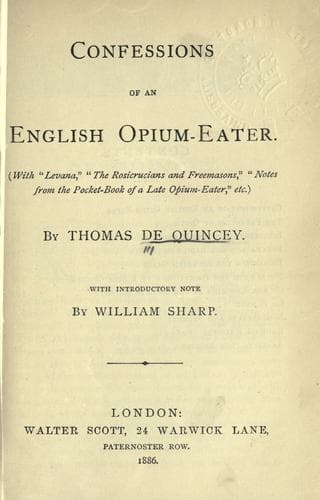
Note Book of an English Opium-EaterDe Quincey, Thomas
Philosophy
Note Book of an English Opium-Eater
De Quincey, Thomas
Opium abuse -- England
and false meaning [which was his own meaning] of the word nature, he had
as undeniably violated the principle of the _natural_, by this metrical
dialogue, as the Italian opera by musical dialogue. If it is hard and
trying for men to sing their emotions, not less so it must be to deliver
them in verse.
But, if this were shocking, how much more shocking would it have seemed to
Addison, had he been introduced to parts which really exist in the Grecian
drama? Even Sophocles, who, of the three tragic poets surviving from the
wrecks of the Athenian stage, is reputed the supreme _artist_ [5] if
not the most impassioned poet, with what horror he would have overwhelmed
Addison, when read by the light of those principles which he had himself
so scornfully applied to the opera! In the very monsoon of his raving
misery, from calamities as sudden as they were irredeemable, a king is
introduced, not only conversing, but conversing in metre; not only in
metre, but in the most elaborate of choral metres; not only under the
torture of these lyric difficulties, but also chanting; not only chanting,
but also in all probability dancing. What do you think of _that_, Mr.
Addison?
There is, in fact, a scale of graduated ascents in these artifices for
unrealizing the effects of dramatic situations:
1. We may see, even in novels and prose comedies, a keen attention paid to
the inspiriting and _dressing_ of the dialogue: it is meant to be life-
like, but still it is a little raised, pointed, colored, and idealized.
2. In comedy of a higher and more poetic cast, we find the dialogue
_metrical_.
3. In comedy or in tragedy alike, which is meant to be still further
removed from ordinary life, we find the dialogue fettered not only by
metre, but by _rhyme_. We need not go to Dryden, and others, of our
own middle stage, or to the French stage for this: even in Shakspeare, as
for example, in parts of Romeo and Juliet (and for no capricious purpose),
we may see effects sought from the use of rhyme. There is another
illustration of the idealizing effect to be obtained from a particular
treatment of the dialogue, seen in the Hamlet of Shakspeare. In that drama
there arises a necessity for exhibiting a play within a play. This
interior drama is to be further removed from the spectator than the
principal drama; it is a deep below a deep; and, to produce that effect,
the poet relies chiefly upon the stiffening the dialogue, and removing it
still farther, than the general dialogue of the _including_ or _outside_
drama, from the standard of ordinary life.
4. We find, superadded to these artifices for idealizing the situations,
even music of an intermitting character, sometimes less, sometimes more
impassioned--recitatives, airs, choruses. Here we have reached the Italian
opera.
Public-domain text, read in full here on John Shaqi.
Reviews
Reviews
No reviews yet
Be the first to share your thoughts on this work.
Elsewhere in the archive
Join the Discussion
Join the discussion
Sign in to leave a comment or review.
Sign InorCreate an account