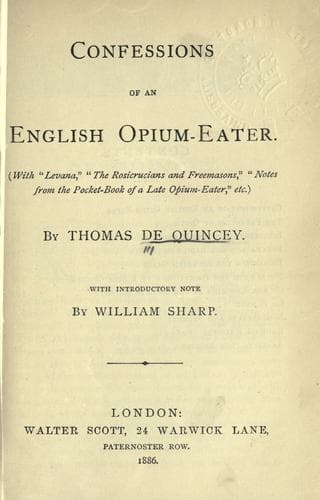
Note Book of an English Opium-EaterDe Quincey, Thomas
Philosophy
Note Book of an English Opium-Eater
De Quincey, Thomas
Opium abuse -- England
5. And, finally, besides all these resources of art, we find dancing
introduced; but dancing of a solemn, mystical, and symbolic character.
Here, at last, we have reached the Greek tragedy. Probably the best
exemplification of a Grecian tragedy that ever _will_ be given to a
modern reader is found in the Samson Agonistes of Milton. Now, in the
choral or lyric parts of this fine drama, Samson not only talks, 1st,
metrically ( as he does every where, and in the most level parts of the
scenic business), but, 2d, in very intricate metres, and, 3d, occasionally
in _rhymed_ metres (though the rhymes are too sparingly and too
capriciously scattered by Milton), and, 4th, _singing_ or chanting
these metres (for, as the chorus sang, it was impossible that _he_
could be allowed to talk in his ordinary voice, else he would have put
them out, and ruined the music). Finally, 5th, I am satisfied that Milton
meant him to _dance_. The office of the _chorus_ was imperfectly
defined upon the Greek stage. They are generally understood to be the
_moralizers_ of the scene. But this is liable to exceptions. Some of
them have been known to do very bad things on the stage, and to come
within a trifle of felony: as to misprision of felony, if there _is_
such a crime, a Greek chorus thinks nothing of it. But that is no business
of mine. What I was going to say is, that, as the chorus sometimes
intermingles too much in the action, so the actors sometimes intermingle
in the business of the chorus. Now, when you are at Rome, you must do as
they do at Rome. And that the actor, who mixed with the chorus, was
compelled to sing, is a clear case; for _his_ part in the choral ode
is always in the nature of an echo, or answer, or like an _antiphony_
in cathedral services. But nothing could be more absurd than that one of
these antiphonies should be sung, and another said. That he was also
compelled to dance, I am satisfied. The chorus only _sometimes_
moralized, but it _always_ danced: and any actor, mingling with the
chorus, must dance also. A little incident occurs to my remembrance, from
the Moscow expedition of 1812, which may here be used as an illustration:
One day King Murat, flourishing his plumage as usual, made a gesture of
invitation to some squadrons of cavalry that they should charge the enemy:
upon which the cavalry advanced, but maliciously contrived to envelope the
king of dandies, before he had time to execute his ordinary manoeuvre of
riding off to the left and becoming a spectator of their prowess. The
cavalry resolved that his majesty should for once ride down at their head
to the melee, and taste what fighting was like; and he, finding that the
thing must be, though horribly vexed, made a merit of his necessity, and
afterwards pretended that he liked it very much. Sometimes, in the
darkness, in default of other misanthropic visions, the wickedness of this
cavalry, their _mechancete_, causes me to laugh immoderately. Now I
Public-domain text, read in full here on John Shaqi.
Reviews
Reviews
No reviews yet
Be the first to share your thoughts on this work.
Elsewhere in the archive
Join the Discussion
Join the discussion
Sign in to leave a comment or review.
Sign InorCreate an account