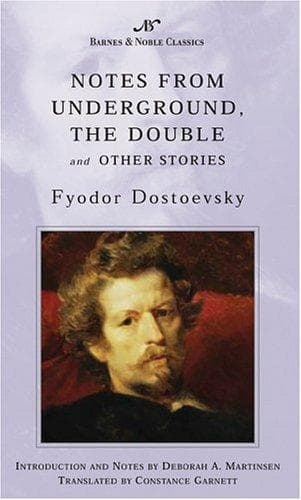
Political fiction; Russia -- History -- 1801-1917 -- Fiction; Russia -- Officials and employees -- Fiction
Gentlemen, I am joking, and I know myself that my jokes are not
brilliant, but you know one can take everything as a joke. I am,
perhaps, jesting against the grain. Gentlemen, I am tormented by
questions; answer them for me. You, for instance, want to cure men of
their old habits and reform their will in accordance with science and
good sense. But how do you know, not only that it is possible, but also
that it is _desirable_ to reform man in that way? And what leads you to
the conclusion that man’s inclinations _need_ reforming? In short, how
do you know that such a reformation will be a benefit to man? And to go
to the root of the matter, why are you so positively convinced that not
to act against his real normal interests guaranteed by the conclusions
of reason and arithmetic is certainly always advantageous for man and
must always be a law for mankind? So far, you know, this is only your
supposition. It may be the law of logic, but not the law of humanity.
You think, gentlemen, perhaps that I am mad? Allow me to defend myself.
I agree that man is pre-eminently a creative animal, predestined to
strive consciously for an object and to engage in engineering—that is,
incessantly and eternally to make new roads, _wherever they may lead_.
But the reason why he wants sometimes to go off at a tangent may just
be that he is _predestined_ to make the road, and perhaps, too, that
however stupid the “direct” practical man may be, the thought sometimes
will occur to him that the road almost always does lead _somewhere_,
and that the destination it leads to is less important than the process
of making it, and that the chief thing is to save the well-conducted
child from despising engineering, and so giving way to the fatal
idleness, which, as we all know, is the mother of all the vices. Man
likes to make roads and to create, that is a fact beyond dispute. But
why has he such a passionate love for destruction and chaos also? Tell
me that! But on that point I want to say a couple of words myself. May
it not be that he loves chaos and destruction (there can be no
disputing that he does sometimes love it) because he is instinctively
afraid of attaining his object and completing the edifice he is
constructing? Who knows, perhaps he only loves that edifice from a
distance, and is by no means in love with it at close quarters; perhaps
he only loves building it and does not want to live in it, but will
leave it, when completed, for the use of _les animaux domestiques_—such
as the ants, the sheep, and so on. Now the ants have quite a different
taste. They have a marvellous edifice of that pattern which endures for
ever—the ant-heap.
Public-domain text, read in full here on John Shaqi.
Reviews
Reviews
No reviews yet
Be the first to share your thoughts on this work.
Join the Discussion
Join the discussion
Sign in to leave a comment or review.
Sign InorCreate an account