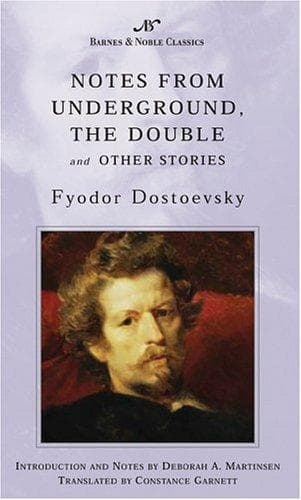
Political fiction; Russia -- History -- 1801-1917 -- Fiction; Russia -- Officials and employees -- Fiction
The very opposite sometimes happened. It was loathsome sometimes to go
to the office; things reached such a point that I often came home ill.
But all at once, _à propos_ of nothing, there would come a phase of
scepticism and indifference (everything happened in phases to me), and
I would laugh myself at my intolerance and fastidiousness, I would
reproach myself with being _romantic_. At one time I was unwilling to
speak to anyone, while at other times I would not only talk, but go to
the length of contemplating making friends with them. All my
fastidiousness would suddenly, for no rhyme or reason, vanish. Who
knows, perhaps I never had really had it, and it had simply been
affected, and got out of books. I have not decided that question even
now. Once I quite made friends with them, visited their homes, played
preference, drank vodka, talked of promotions.... But here let me make
a digression.
We Russians, speaking generally, have never had those foolish
transcendental “romantics”—German, and still more French—on whom
nothing produces any effect; if there were an earthquake, if all France
perished at the barricades, they would still be the same, they would
not even have the decency to affect a change, but would still go on
singing their transcendental songs to the hour of their death, because
they are fools. We, in Russia, have no fools; that is well known. That
is what distinguishes us from foreign lands. Consequently these
transcendental natures are not found amongst us in their pure form. The
idea that they are is due to our “realistic” journalists and critics of
that day, always on the look out for Kostanzhoglos and Uncle Pyotr
Ivanitchs and foolishly accepting them as our ideal; they have
slandered our romantics, taking them for the same transcendental sort
as in Germany or France. On the contrary, the characteristics of our
“romantics” are absolutely and directly opposed to the transcendental
European type, and no European standard can be applied to them. (Allow
me to make use of this word “romantic”—an old-fashioned and much
respected word which has done good service and is familiar to all.) The
characteristics of our romantic are to understand everything, _to see
everything and to see it often incomparably more clearly than our most
realistic minds see it;_ to refuse to accept anyone or anything, but at
the same time not to despise anything; to give way, to yield, from
policy; never to lose sight of a useful practical object (such as
rent-free quarters at the government expense, pensions, decorations),
to keep their eye on that object through all the enthusiasms and
volumes of lyrical poems, and at the same time to preserve “the sublime
and the beautiful” inviolate within them to the hour of their death,
and to preserve themselves also, incidentally, like some precious jewel
wrapped in cotton wool if only for the benefit of “the sublime and the
beautiful.” Our “romantic” is a man of great breadth and the greatest
Public-domain text, read in full here on John Shaqi.
Reviews
Reviews
No reviews yet
Be the first to share your thoughts on this work.
Join the Discussion
Join the discussion
Sign in to leave a comment or review.
Sign InorCreate an account