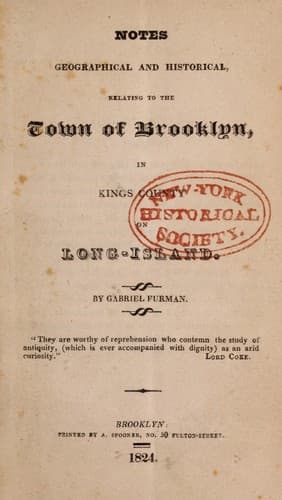
Notes Geographical and Historical, Relating to the Town of Brooklyn in Kings County on Long-Island — John Shaqi
Notes Geographical and Historical, Relating to the Town of Brooklyn in Kings County on Long-IslandFurman, Gabriel
History
Notes Geographical and Historical, Relating to the Town of Brooklyn in Kings County on Long-Island
Furman, Gabriel
Brooklyn (New York, N.Y.) -- History
This town had a full share of the military operations during the
Revolutionary war; and was for a long time in the possession of the
British army. It is covered with the remains of fortifications which
were thrown up by the Americans[14] and English for their defence
against each other. In this town was fought the most sanguinary part of
the battle of Long-Island, August 27, 1776; which took place on the
retreat of the American army within their lines, and the attempt of a
portion of them to ford the mill ponds at Gawanos; in which attempt
nearly the whole of a Regiment of young men from Maryland were cut off.
Many of the minor events connected with this battle, and the
Revolutionary contest, are fast sinking into the shades of oblivion:
the compiler has therefore thought proper to give place to the following
piece of history, not with an idea, that he can immortalize any event
which he relates; but with a hope, that his efforts will call forth some
nobler pen to do justice to the memories of many of the almost forgotten
heroes of those hard fought battles, and arduous contests. In the battle
above-mentioned, part of the British army marched down a lane or road
leading from the Brush tavern to Gowanos, pursuing the Americans.
Several of the American riflemen, in order to be more secure, and at the
same time, more effectually to succeed in their designs, had posted
themselves in the high trees near the road. One of them, whose name is
now partially forgotten, shot the English Major Grant; in this he passed
unobserved. Again he loaded his deadly rifle, and fired--another English
officer fell. He was then marked, and a platoon ordered to advance, and
fire into the tree; which order was immediately carried into execution,
and the rifleman fell to the ground, dead. After the battle was over,
the two British officers were buried in a field, near where they fell,
and their graves fenced in with some posts and rails, where their
remains still rest. But for “an example to the rebels,” they refused to
the American rifleman the rites of sepulture; and his remains were
exposed on the ground, till the flesh was rotted, and torn off his bones
by the fowls of the air. After a considerable length of time, in a heavy
gale of wind, a large tree was uprooted; in the cavity formed by which,
some friends to the Americans, notwithstanding the prohibition of the
English, placed the brave soldier’s bones to mingle in peace with their
kindred earth.
August 28, 1776. Before day break, in a very thick fog, General
Washington retreated with his army from near the old ferry, Brooklyn, to
New-York. As the last boat of the Americans left the shore, the fog
dissipated, and the British made their appearance on the hills above the
place of embarkation, when a shot or two from an American Battery on the
hill near the house of Col. Henry Rutgers, in New-York, compelled the
British to desist in their march to the ferry.
Public-domain text, read in full here on John Shaqi.
Reviews
Reviews
No reviews yet
Be the first to share your thoughts on this work.
Join the Discussion
Join the discussion
Sign in to leave a comment or review.
Sign InorCreate an account