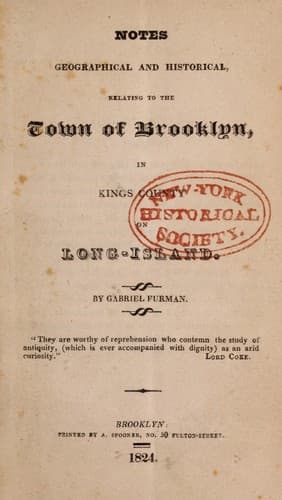
Notes Geographical and Historical, Relating to the Town of Brooklyn in Kings County on Long-IslandFurman, Gabriel
History
Notes Geographical and Historical, Relating to the Town of Brooklyn in Kings County on Long-Island
Furman, Gabriel
Brooklyn (New York, N.Y.) -- History
A short time after the retreat of the Americans, Captain Hale, of the
American army, was dispatched by General Washington, to see if the
English had taken possession of his camp at Brooklyn, and what their
situation was. This unfortunate young officer was taken by the English
and hung as a spy, without even a form of trial; and not allowed a
clergyman at his execution. It is believed he was executed somewhere
along the Brooklyn shore, to the south-west of the old ferry. In our
pity for Major Andre, we have almost entirely lost sight of this
meritorious officer, whose claims on our gratitude ought ever to be
remembered, in proportion as his sufferings were greater than those of
the former.
During the stay of the American army on Long-Island, the head quarters
of General Washington were at the house on Brooklyn heights, now owned
and occupied by Henry Waring, Esq. The house now owned and occupied by
Teunis Joralemon, Esq. was used by the English as a Hospital during the
Revolution, and in its vicinity, hundreds of British soldiers and
sailors are buried.
Most of the records of this town were destroyed by the English when they
came in possession of it after the battle of Long-Island.
In the month of November, 1776, one of the British prison ships, called
the Whitby, was moored in the Wallaboght, near Remsen’s mills. On board
this vessel great mortality prevailed among the prisoners, and many of
them died. Those of the prisoners who died from this ship, and from the
others, which were afterwards brought to this place, were interred in
the hill at the present Navy-Yard; where their remains were found, and
in the year 1808, deposited in a vault erected for that purpose. March
1777, two other prison ships anchored in the Wallaboght, one of which
bore the name of Good Hope; which vessel in the month of October, in the
same year, took fire and was burnt. The prisoners were saved and
transferred to the other vessels.--The hull of this ship lies under a
dock at the Navy Yard, in this town. In the month of February, 1778, on
a Sunday afternoon, another British prison ship was burnt in the
Wallaboght. The hull of this vessel lies in the mud in that Bay. 1778,
the Jersey ship of the line, having arrived at New-York, was condemned
as unfit for the service, and converted into a prison ship. As such she
anchored in the Wallaboght during the month of April, in the same year,
together with the Falmouth and Hope, for Hospital ships; where they
remained till the close of the Revolutionary war.
October 22, 1779, An act of attainder was passed by the Legislature of
this State, against John Rapalje, Esq. of this town, by which his
property was confiscated to the use of the State. That part of his
property lying within the bounds of the present village of Brooklyn, was
on the 13th of July, 1784, sold by the Commissioners of Forfeitures, to
Comfort, and Joshua Sands, Esqrs. for £12,430.
Public-domain text, read in full here on John Shaqi.
Reviews
Reviews
No reviews yet
Be the first to share your thoughts on this work.
Join the Discussion
Join the discussion
Sign in to leave a comment or review.
Sign InorCreate an account