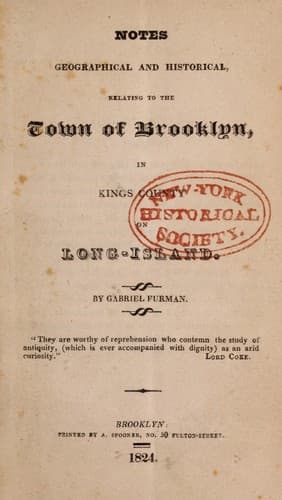
Notes Geographical and Historical, Relating to the Town of Brooklyn in Kings County on Long-IslandFurman, Gabriel
History
Notes Geographical and Historical, Relating to the Town of Brooklyn in Kings County on Long-Island
Furman, Gabriel
Brooklyn (New York, N.Y.) -- History
In the year 1780, the British being apprehensive of an attack from the
American army under General Washington, commenced fortifying the high
grounds about Brooklyn; which works they continued until the peace in
1783. In this town the British had their army yard, where their forage
department, and blacksmith’s shops, &c. were kept. The entrance to this
yard was near the junction of Main-street with Fulton-street, in the
present village of Brooklyn.
During the Revolution, this place was much resorted to by the officers
of the English army, and the fashionables of the day, as a scene of
amusement. In the Royal Gazette of August 8th, 1781, published at
New-York, Charles Loosley advertises a Lottery of $12,500, to be drawn
at “Brooklyn Hall.” The same paper contains the following advertisement:
“Pro bono publico. Gentlemen that are fond of fox hunting, are requested
to meet at Loosley’s Tavern, on Ascot Heath, on Friday morning next,
between the hours of five and six, as a pack of hounds will be there
purposely for a trial of their abilities: Breakfasting and Relishes
until the Races commence.--At eleven o’clock will be run for, an elegant
saddle, &c. value at least twenty pounds, for which upwards of twelve
gentlemen will ride their own horses.--At twelve, a match will be rode
by two gentlemen, Horse for Horse.--At one, a match for thirty guineas,
by two gentlemen, who will also ride their own horses.--Dinner will be
ready at two o’clock, after which, and suitable regalements, racing and
other diversions, will be calculated to conclude the day with pleasure
and harmony. Brooklyn Hall, 6th August, 1781.”
Lieutenant Anberry, in a letter from New-York, to a friend in England,
dated October 30th, 1781, says, “on crossing the East River from
New-York, you land at Brooklyn, which is a scattered village, consisting
of a few houses. At this place is an excellent Tavern, where parties
are made to go and eat fish; the landlord of which has saved an immense
fortune this war.” The public house referred to in the above
advertisements, and letter, was the same house, which after the
Revolution, and in the Compiler’s recollection, was called the
“Corporation House.” It was a large, gloomy, old fashioned, stone
edifice; and was destroyed by fire, September 23d, 1812.
This town was left by the British troops, the same day that they
evacuated New-York.
ANCIENT GOVERNMENT.
Public-domain text, read in full here on John Shaqi.
Reviews
Reviews
No reviews yet
Be the first to share your thoughts on this work.
Join the Discussion
Join the discussion
Sign in to leave a comment or review.
Sign InorCreate an account