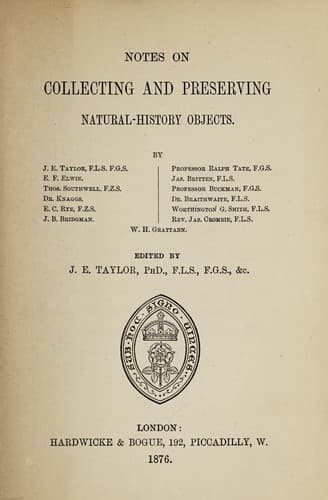
Notes on Collecting and Preserving Natural-History Objects — John Shaqi
Notes on Collecting and Preserving Natural-History Objects
Science
Notes on Collecting and Preserving Natural-History Objects
Botanical specimens -- Collection and preservation; Zoological specimens -- Collection and preservation
But the first main point is that of getting the forms, peculiarities,
names, and positions of the bones of one skeleton fully impressed on
the student's mind. As to the books which are to help him to do this,
it is very hard to know what to recommend. As far as I know, there is
no really luminous book on osteology in existence. So far as learning
the names and peculiarities of the bones, nothing could be better
or more to the purpose than Flower's 'Osteology of the Mammalia';
but this treats only of one class, and does not get beyond technical
description. The first and second volumes of Owen's 'Comparative
Anatomy of Vertebrates' fill the gap the best of any, and yet these are
by no means what we really want. There is a good deal about bones in
Huxley's 'Anatomy of Vertebrated Animals,' but in such a fragmentary
and scattered form as to be of little use. The fact is, the field is
yet open for an Osteological Manual. Much has been written on the
subject. Pages of precise and accurate description, beautiful and
artistic sheets of plates of bones without number, can be seen in
any scientific library. But this is only half the matter. We want
to advance a step farther. It is the relation between structure and
function which needs working out.
When a new bone finds its way into the student's hands, he observes
some peculiarity in shape or structure in which it differs from the
bones he is already acquainted with; the question naturally occurs to
him, Why does this bone assume one shape in one animal, and in another
is modified into a different form? He may look in vain in his books for
an answer to his query. And yet it is points like these which, in my
opinion, make up the true science of Osteology. It is through careful,
constant, and intelligent observation, that these enigmas are to be
solved. Observation, indoors and out; close attention to the habits of
the animal in question, on the one hand, and careful consideration of
its anatomical peculiarities, on the other.
Let me give an instance of this, first of all taking it as an axiom
that everything has been done with a purpose. Take, then, the skull
of a crocodile. What do we find? The orbits of the eyes, the nasal
orifice, the passages leading to the auditory apparatus, all situated
on a plane, along the upper flattened surface of the head. What,
then, is the cause of this? Palpably to allow the crocodile to remain
submerged in the water, with its nose, eyes, and ears just above the
surface to warn him of the approach of enemies or prey, and the rest of
his carcase securely hidden beneath the waters.
Public-domain text, read in full here on John Shaqi.
Reviews
Reviews
No reviews yet
Be the first to share your thoughts on this work.
Join the Discussion
Join the discussion
Sign in to leave a comment or review.
Sign InorCreate an account