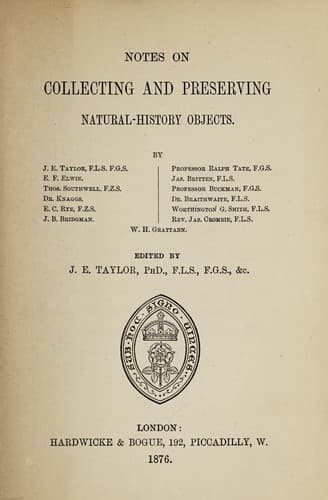
Notes on Collecting and Preserving Natural-History Objects — John Shaqi
Notes on Collecting and Preserving Natural-History Objects
Science
Notes on Collecting and Preserving Natural-History Objects
Botanical specimens -- Collection and preservation; Zoological specimens -- Collection and preservation
Take another instance. Observe the habits of a mole. With what
rapidity it burrows underground, shovelling away the earth with its
fore feet. Then look at its skeleton. We find just what we should
have expected. The bones of its fore legs of astounding strength and
breadth, furnished with deep grooves, which, together with its sternum
or breastbone, which is furnished with a keel almost like that of the
sternum of a bird, afford attachment to the powerful muscles. Its hind
legs, being simply needed for locomotion, are of the normal size. So,
also, with the birds. The size of the keel of the sternum varies in
proportion to the powers of flight which each species requires, for it
is to the broad surfaces of the sternum that the great wing-muscles are
attached. Take the skeleton of a hummingbird, which spends its life
almost upon the wing. We find there a keel of so vast a size, that the
remainder of the skeleton is reduced to insignificance in comparison.
Of course, these instances that I have given are all of the most
obvious nature, but they serve to show my meaning; and the same line of
reasoning can, I am sure, be extended to all the more minute points in
osteological structure.
In these researches, one is soon struck by the fact that in the
modifications in various bones, or sets of bones, in accordance with
the habits of each animal, the original type is never departed from,
only modified. See, for example, the paddle of a whale. More like the
fin of a fish in general appearance, and yet the same set of bones
which are found in the arm of a man, are again found in an adapted form
in the paddle of the whale. So, also, the fore leg of a horse preserves
the same general plan. What is generally called its knee is in reality
its wrist. It is there that we find the little group of bones which
forms the carpus. All below it answers to our hand--a hand consisting
of one finger.
Take even a wider instance. Compare the arm of a man and the wing
of a bird. Still greater adaptations have taken place, and yet the
plan remains the same. We still find the clavicle or collar-bone, the
scapula or shoulder-blade, the humerus, ulna, and radius, answering to
the same bones of our arm, a small carpus or wrist, and finally the
phalanges or fingers, simplified and lengthened and anchylosed to form
but one series of bone, with the exception of a rudimentary thumb. It
is not uncommon to find a rudimentary bone like this which in some
allied species is fully developed. The leg of the horse again gives us
a very striking example of this. There is, so to speak, only a single
finger, but we find, one on each side of this single finger, two small
bones, commonly known only as splint-bones. These are the rudimentary
traces of the same finger-bones, which in the rhinoceros are fully
developed.
Public-domain text, read in full here on John Shaqi.
Reviews
Reviews
No reviews yet
Be the first to share your thoughts on this work.
Join the Discussion
Join the discussion
Sign in to leave a comment or review.
Sign InorCreate an account