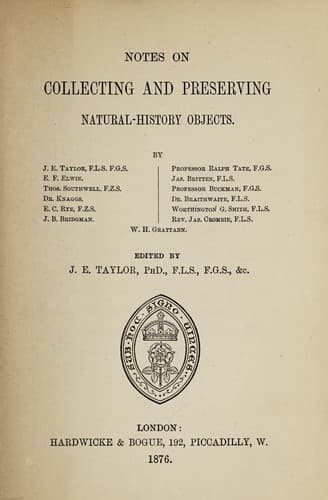
Notes on Collecting and Preserving Natural-History Objects
Science
Notes on Collecting and Preserving Natural-History Objects
Botanical specimens -- Collection and preservation; Zoological specimens -- Collection and preservation
Some prefer to keep their collections in well-made store boxes, which
possess many advantages over the cabinet; for example, they may be kept
like books in a bookcase, the upright position rendering the contents
less liable to the attacks of mites; they are more readily referred to,
and are more portable, and they admit of our gradually expanding our
collections to any extent. Cabinets, on the other hand, are preferred
by many, for the reasons that they are compact and generally form
a handsome article of furniture; moreover, good cabinets are made
entirely of mahogany, which is the best wood for the purpose; deal, and
other woods containing resinous matter, having a decidedly injurious
effect on the specimens. As a preservative, there is, after all,
perhaps nothing better than camphor; but it should be used sparingly,
or its tendency will be to cause greasiness of the specimens.
V.
BEETLES.
By E. C. Rye, F.Z.S., etc.
The general rules, so ably expounded by Dr. Knaggs in his instructions
for collecting _Lepidoptera_, as to constant alertness and making "the
reason why" the starting-point of investigation, apply with equal force
to the collector of _Coleoptera_, and need not be here recapitulated.
But they do not, in the instance of the latter, require generally to
be observed, except as to the perfect state of beetles; for, owing
to the hidden earlier conditions of life of most of those insects,
and to the long period during which these conditions exist, it is but
seldom that the pursuit of rearing them, so universally and profitably
adopted by the Lepidopterist, is found of much use to the collector
of beetles. And this is very much to be regretted; because, in the
majority of cases, if the latter succeed in rearing a beetle from its
earliest stage, and keep proper notes of its appearance and habits,
he will probably be adding to the general stock of knowledge, as the
lives of comparatively few, even of the commonest species, are recorded
from the beginning. It may be, also, in addition to the reasons above
mentioned, for the usual want of success attending the rearing of
beetle larvæ, that the fact of bred specimens being frequently (from
the artificial conditions attending their development, and from their
not being allowed that length of time which, in a state of nature,
they require after their final change before they are ready to take an
active part in their last stage of life) not nearly so good as those
taken at large, militates considerably against the more general use
of this method of adding to a collection. In this respect, of course,
the Lepidopterist is actuated by precisely opposite motives; as for
him, a bred specimen is immeasurably superior to one captured. And the
fact of so few beetle larvæ being known at all, or, if known, only
to the possessor of somewhat rare books, renders it very likely that
a mere collector, finding a considerable expenditure of patience and
Public-domain text, read in full here on John Shaqi.
Reviews
Reviews
No reviews yet
Be the first to share your thoughts on this work.
Join the Discussion
Join the discussion
Sign in to leave a comment or review.
Sign InorCreate an account