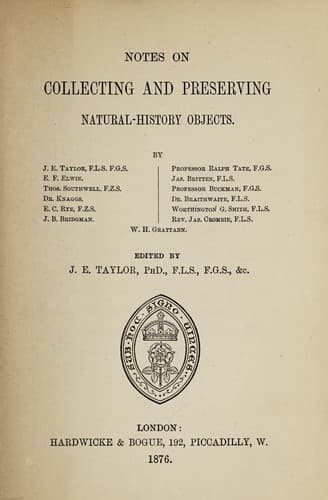
Notes on Collecting and Preserving Natural-History Objects
Science
Notes on Collecting and Preserving Natural-History Objects
Botanical specimens -- Collection and preservation; Zoological specimens -- Collection and preservation
trouble result in the rearing of a species of which he could at any
time readily procure any number of specimens, may very probably abandon
rearing for the future.
These observations, however, are not in the least intended to dissuade
anyone from breeding or endeavouring to breed beetles. On the contrary,
it is obvious from them that it is precisely by attending to these
earlier stages that the earnest student (novice or expert) has the
most chance of distinguishing himself, on account of the more open
field for discovery. And in the instance of many small, and especially
gregarious, beetles, breeding from the larvæ is frequently very easy,
if only the substances (fungus, rotten wood, roots, stems of plants,
&c.) containing them be carefully left in precisely the state as when
found, and be exposed to the same atmospheric or other important
conditions. In fact, to ensure success and good specimens, it is best
that in their early stages beetles should be "let alone severely."
It may be here observed that we have been lately in this country
indebted to the minute observations and great tact of some of our best
students of _Micro-Lepidoptera_ (in which branch of entomology we are
second to none in Europe) for some most interesting additions to our
knowledge of habits, and for long series of beetles usually rare in
collections.
Dismissing then the earlier stages of beetles, the following
observations will apply only to the imago, or "beetle proper." And here
I would repeat how evident it is that the knowledge of "the reason
why" is especially indispensable to the beetle collector, judging from
the extreme rarity of the occurrence of any new or valuable insect
in the stores of a mere random collector or a beginner. For him, no
old hand detects an equivalent to _Daplidice_ or _Lathonia_ in his
duplicate boxes; whereas, among Lepidopterists, "school-boy's luck" is
proverbial. I can give no reason for this statement, founded on my own
(by no means trifling) experience in the way of examining specimens.
And in this idea I think I am corroborated by the very great rarity in
old collections and records of many species now universally common;
the directions in older manuals, as to looking under stones, on walls,
paths, &c., pretty clearly showing that the majority of captures in
the olden time were what are now irreverently designed as "flukes."
Still, it is astonishing to what good account a sharp observer may turn
these casual meetings, often to him resulting in the discovery of "the
reason why" as to the particular species accidentally found, and to the
correlative increase of his collection. And, apart from captures during
collecting expeditions, good things will at times occur to the alert
entomologist: one, for instance, who will startle his friends in the
streets by suddenly swooping with his hat after an atom flying in the
sunshine, or who is not too proud to pick up another, racing on the hot
Public-domain text, read in full here on John Shaqi.
Reviews
Reviews
No reviews yet
Be the first to share your thoughts on this work.
Join the Discussion
Join the discussion
Sign in to leave a comment or review.
Sign InorCreate an account