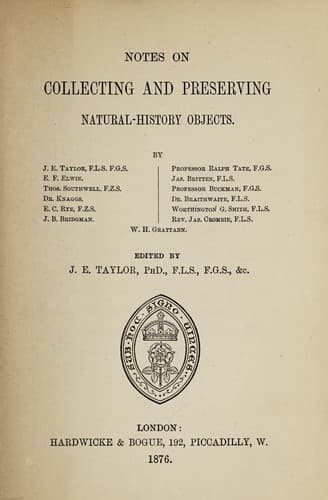
Notes on Collecting and Preserving Natural-History Objects
Science
Notes on Collecting and Preserving Natural-History Objects
Botanical specimens -- Collection and preservation; Zoological specimens -- Collection and preservation
Beating is most productive in early summer, especially in the second
year's growth of young cuttings in woods; and the oak, hazel, and
poplar will generally yield many species to the tap of the stick.
Good thick, and especially _old_ hedges, must also be always carefully
thrashed into the net; very many good things, otherwise not procurable,
will reward this toil. Another scheme for getting rare species is to
beat the tops of trees with a long pole, placing beneath a sheet or
tent covering.
Breaking away the extreme edges of banks, throwing water on them,
treading heavily on the margins, diligently examining grass and roots
close to the water, reeds (especially if cut and on the ground in
heaps), &c., will bring to light great numbers of wet-loving beetles.
Water beetles, pure and simple, must be dragged and dredged for,
especially round water plants beneath the surface, and along the sides
of ponds, in eddies of running streams, in the moss on stones in them,
and on the stones themselves, &c.
The _Coprophaga_ will be found readily in the droppings of various
_Mammalia_, and also in holes bored in the ground beneath, often
to a great depth. An easy and clean way to secure them is to throw
droppings, ground and all, into water, the beetles coming to the
surface.
As to wood beetles, they must be sought for under and in bark, in solid
wood, in decaying branches, and such places; a rule to be remembered
is, that most of these occur at the _tops_ of trees: hence the paucity
of so many species in collections. Indeed, to properly hunt for the
majority of them, it is necessary to obtain _carte blanche_ and a
ladder, if any success be hoped for. Felled trunks are, of course, easy
to manipulate; and their freshly-cut stumps, exuding either resin or a
peculiar and often sweet _mucor_, are very attractive to many beetles,
as is freshly-cut sawdust, and most especially the (to us) fetid and
acrid juice resulting from the attacks of the larva of the Goat-moth.
Rotten fruit, &c., are also not to be passed by without examination.
Many small species occur in, or can be obtained from, the topmost twigs
of trees blown down by the wind.
Dead animals, as before mentioned, must be examined, as must the
vegetation and soil near them. A keeper's tree in a wood will always
produce something for the collector, who need only hold his net
beneath the gibbeted _feræ_ and bang their hides and bones with
his beating-stick. During different stages of decomposition and
desiccation, beetles of widely varied affinities will result from this
method of collecting.
Public-domain text, read in full here on John Shaqi.
Reviews
Reviews
No reviews yet
Be the first to share your thoughts on this work.
Join the Discussion
Join the discussion
Sign in to leave a comment or review.
Sign InorCreate an account