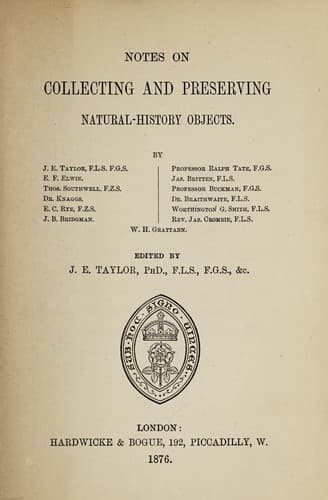
Notes on Collecting and Preserving Natural-History Objects
Science
Notes on Collecting and Preserving Natural-History Objects
Botanical specimens -- Collection and preservation; Zoological specimens -- Collection and preservation
Ants' nests would require a special notice, so productive are they:
their material can be sifted and their neighbouring "runs" or paths
examined, traps laid near or on them, and periodically cleared out,
&c. Bees' and wasps' nests also produce good, though fewer species,
and are, moreover, not quite so easy of access. The nests of birds,
especially if the latter are gregarious, and, indeed, the habitations
of any animals, will be found to harbour many beetles, amongst other
insects.
In gardens, the beetle collector should lay cunning traps of cut grass,
twigs, planks, bones, &c.; by a periodical examination of which he will
secure many good things. If there be a hothouse about the premises, it
and its belongings will always act as a bait.
Large tracts of waste land and commons, though superficially apparently
unproductive, often contain congregations of good species, in some
little oasis of damp or vegetation; moreover, on them several peculiar
beetles occur. Hills and mountains will often suddenly repay the toil
of the collector, who has despondently worked his way up, turning over
stones, and finding comparatively nothing. The moss, &c., attending the
channels of any streams in such places should be carefully searched,
and the stones on the top especially not neglected. River banks and
salt marshes are invariably frequented by good insects, and the very
heaps of seaweed, dry or wet, on the shore harbour countless beetles.
In such places small sand-loving plants should be pulled up by the
roots, and, with the neighbouring soil, shaken over brown paper. The
sand itself may in many instances be scraped, and burrowing beetles
brought to light; but if the hunter comes upon a dead fish or bird, a
full bottle will be his.
Thus it will be seen that almost every locality contains beetles,
if the collector can only detect them (and it may be as well here
to impress on him that it is better to bottle a dubious insect and
examine it at home, than to reject it for being _apparently_ common).
Still there can be no doubt that certain soils and districts are much
more productive than others; for instance, most of the midland and
western counties, and some of the south-western, are not by any means
so prolific as the eastern, southern, and many parts of the northern
districts of Great Britain; clay being the worst of all soils for the
Coleopterist.
Public-domain text, read in full here on John Shaqi.
Reviews
Reviews
No reviews yet
Be the first to share your thoughts on this work.
Join the Discussion
Join the discussion
Sign in to leave a comment or review.
Sign InorCreate an account