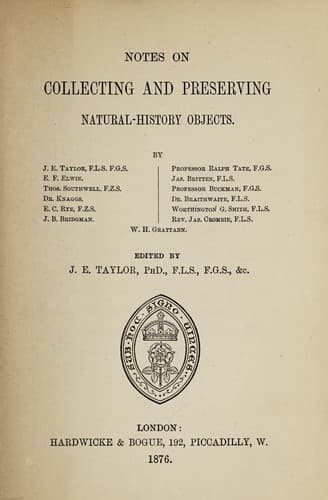
Notes on Collecting and Preserving Natural-History Objects
Science
Notes on Collecting and Preserving Natural-History Objects
Botanical specimens -- Collection and preservation; Zoological specimens -- Collection and preservation
plan of proceeding, after having got one in the net, is to catch hold
of the net so that the insect is inclosed in a sort of sack, I then
uncork the cyanide, and introduce that into the sack, holding the net
firmly round the neck of the bottle, so that there is no other escape
for the insect from the net but into the bottle, then gradually work
the insect into the bottle and close the mouth with several folds of
the net, watch my opportunity and insert the cork: when the insect is
stupefied, which happens in a few seconds if the bottle is slightly
warm, I turn it into the pill-box. A word of caution: it is necessary
to be methodical in carrying the boxes. I always keep the empty ones in
my right-hand pocket, and the filled ones in the left-hand one, as, if
they are carried sometimes one way, sometimes another, sooner or later
a previously filled one will be opened to put an insect in, which will
result in the former tenant speedily making room for the new comer; and
my experience has been, if you do lose anything it is generally your
best capture.
Having got home with the left-hand pocket more or less filled, turn
the boxes out, preparatory to killing the contents, which must be done
with burnt sulphur. My mode of proceeding is as follows:--I stupefy
the contents of each box with chloroform, in a manner I will describe
farther on. Having stupefied them, I empty them all into a short,
wide-mouthed, round bottle, having a piece of glass tube put through
the cork; the mouth of the tube is plugged with cotton wool, not too
tight, to act as a strainer. I then put this in a Nabob pickle-bottle
(any other bottle will do as well), through the stopper of which I have
drilled a hole about a sixteenth of an inch in diameter, in which is
fixed a copper wire, having a shallow tin cup at the end. In this tin
cup is placed the sulphur. The tin cup is then held over the flame of a
lamp, gas, or candle, till the sulphur is burning, then put it into the
bottle and press it down. When all the oxygen is consumed the sulphur
goes out. Leave them for about three hours, take them out, and put
them into a damp box for twelve or more hours: they will then be in a
splendid condition for setting. To stupefy the insects I tip the lids
on one side, put them into the sulphur bottle, pour a drop or two into
the tin cup, and put it into the bottle. Be careful not to chloroform
them too much, as if killed so they become so rigid that it is with
difficulty they can be set.
Public-domain text, read in full here on John Shaqi.
Reviews
Reviews
No reviews yet
Be the first to share your thoughts on this work.
Join the Discussion
Join the discussion
Sign in to leave a comment or review.
Sign InorCreate an account