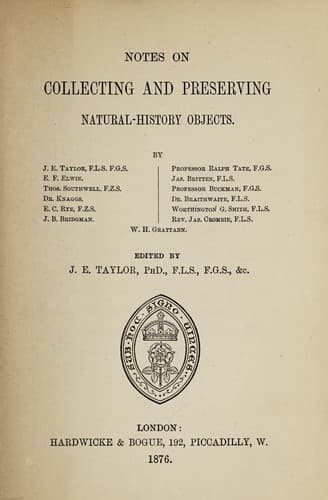
Notes on Collecting and Preserving Natural-History Objects
Science
Notes on Collecting and Preserving Natural-History Objects
Botanical specimens -- Collection and preservation; Zoological specimens -- Collection and preservation
The collector will do well, after a first hurried "burst" at all
beetles that come in his way, to select a special group, and lay
himself out to work it carefully, buying or borrowing the works
of authorities upon it, and making himself master of the _botany_
connected with it, if it be a group of plant-frequenting habits. By
such a way of working, he will more quickly, though step by step,
acquire a good collection, and a stock of useful knowledge, than by
any other. He will of course keep a register of the date and place of
capture, and any peculiarity of habit of each insect he takes. Figures
of the date of the year (usually the last two are sufficient), followed
by another set, commencing with 1, will generally be quite enough;
corresponding entries being made in the first column of a ruled diary.
These figures may be written in ink on the under side of the card of a
mounted specimen, or on a circular disc of paper, pierced by the pin of
one too large to be carded.
VI.
HYMENOPTERA.
By John B. Bridgman.
Having been asked to give some instructions as to the method of setting
and preserving the aculeate _Hymenoptera_, it is with great pleasure I
comply, and I hope it may be the means of inducing others to collect
these insects. To begin at the beginning, it is almost needless to
state that the females of all of them (a few of the ants excepted)
are furnished with stings, but with very little care one need never
be stung. As Mrs. Glass says, "First catch your hare": so first I
shall give a few instructions where to look for and how to catch these
insects. All the apparatus necessary is a gauze ring-net, a cyanide
bottle, and a pocket full of small card pill-boxes; the cyanide bottle
is best made by wrapping a small piece of cyanide of potassium in two
or three thicknesses of blotting-paper, tying it round with cotton to
prevent it shaking out, then fixing it to the bottom of a wide-mouthed
flat bottle with sealing-wax, which is made to adhere firmly to the
glass by heating the glass carefully over a lamp, and then corking
it up. The pill-boxes ought to have the tops and bottoms fastened in
with liquid glue (a preparation of shell-lac). These are all that are
required to catch and bring home the game; which is to be looked for
at the flowers of trees, bushes, and plants--one season's experience
will teach the best, as some species frequent one, some another, and
some almost all. The flowers I have found the greatest favourites are
sallows, willows, sycamore, holly, blackthorn, bramble, hawkweeds,
ragwort, thistles, and umbelliferæ. Some bore in putrescent wood,
and must be looked for on or in the neighbourhood of old posts and
palings; some are to be found flying about dry banks, hard-trodden
pathways, on heaths, while old sand pits are favourite places; but
they should be sought for in any warm, rough, weedy spot; and some may
be obtained by digging them out of their burrows with a trowel. My
Public-domain text, read in full here on John Shaqi.
Reviews
Reviews
No reviews yet
Be the first to share your thoughts on this work.
Join the Discussion
Join the discussion
Sign in to leave a comment or review.
Sign InorCreate an account