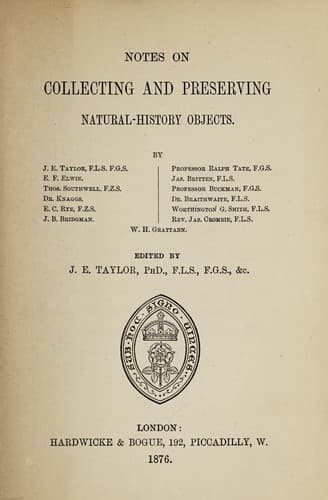
Notes on Collecting and Preserving Natural-History Objects
Science
Notes on Collecting and Preserving Natural-History Objects
Botanical specimens -- Collection and preservation; Zoological specimens -- Collection and preservation
One more observation and I have done. Sometimes one comes across an
insect whose rigid wings seem to defy all attempts to set; in such
cases just press firmly at the back part of the thorax, between that
and the abdomen, towards the pin, and the wings will sometimes fly open
of their own accord, or will allow of their being easily set in the
required direction, which should always be set well forward.
VII.
LAND AND FRESHWATER SHELLS, ETC.
By Professor Ralph Tate, F.G.S., etc.
A young friend, desirous of entering upon one of the most accessible
natural history pursuits, that of the study of Land and Freshwater
Molluscs, begged of me some practical hints on the collection
and preservation of these objects of our woodlands, waysides,
and watercourses. Believing that this kind of work offers a good
stepping-stone to the study of nature in its more extended forms and
complicated relations, I was most anxious to help my tyro naturalist,
and that beyond his utmost expectations, as I made a few initiatory
trips with him in a search for the coveted treasures.
Our equipment was simple and inexpensive, consisting of a block-tin
saucepan finely perforated at the bottom, about six inches across, and
having a hollow handle of a size to receive firmly the end of a common
walking-stick--such a _dredge_ or a _sifter_ will cost ninepence or a
shilling at a tinman's; secondly, of a pocket lens; and lastly, of a
variety of boxes, and a bag to contain specimens of different sizes.
Thus provided, our first excursion had for its object an examination
of certain neighbouring ponds and streams. My pupil, guessing the use
of the perforated saucepan, makes his way to the nearest pond, fixes
the improvised handle, dashes in the _sifter_ with impatient ardour,
and having brought up a quantity of mud from the bottom, looked upon
the oozy mass with despair. Patience, my lad! Remember that the
pleasure of success in science is the higher the greater the labour
expended in obtaining the objects of our search. Expect failure now
and again, but do not be disheartened. _Ohne Hast ohne Rast_, should
be the motto of every naturalist. Now, shake the tin in the water,
keeping its rim just out of the water, dipping it down now and then.
That is well; thus you see that you have cleared off the mud, and what
you want is probably left behind along with the rubbish. What, nothing!
Come, try again; but this time scrape the sifter along the surface of
the mud, and I am confident that you will find something to reward you,
and with much less trouble and display of temper. In this way, after
repeated trials, a number of shells were secured and transferred to
the boxes. Then, after the first gush of excitement is over, we retire
to an adjoining bank to con over the spoils, and I to make mention
of the various habits of freshwater snails, and consequently of the
different modes of search. My young friend's enthusiasm is aroused by
Public-domain text, read in full here on John Shaqi.
Reviews
Reviews
No reviews yet
Be the first to share your thoughts on this work.
Join the Discussion
Join the discussion
Sign in to leave a comment or review.
Sign InorCreate an account