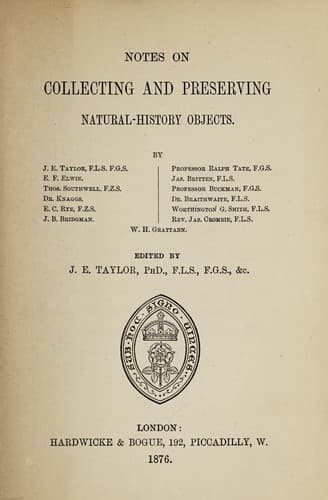
Notes on Collecting and Preserving Natural-History Objects
Science
Notes on Collecting and Preserving Natural-History Objects
Botanical specimens -- Collection and preservation; Zoological specimens -- Collection and preservation
the mention that a few large mussel-like shells are inhabitants of our
fresh waters, and great is his haste to be up and again doing, in the
hope of adding some of them to his stock. But in vain were his many
attempts to find them in the pond which had already yielded us such a
variety. "Do they live here?" is at last the anxious question. "No; but
let us away to yon sluggish brook, for it is in such that we may expect
to meet with them." "Now I see them. Are not those their ends just
peeping above the mud?" And full of eagerness he dashes in the dredge,
but with little result, excepting that of a dead shell or two. "Oh! how
can I get them? Shall I take off my shoes and socks and wade for them?"
"Well, you might secure them that way, and sometimes it is the only
way, but on this occasion I do not think it necessary. Come, we will
move a little higher up, where the stream is clear, and the shellfish
undisturbed. Observe the gaping ends of the shell, and thus I push the
end of the stout rod between the partially-open valves; now they close
upon the stick, and so we bring our prize holding on to the stick to
the bank."
"You will recollect," addressing my companion, "that in the muddy pond
we have just left, we chiefly got small bivalves and only a few snail
shells. I have already told you that water shells differ much in their
habits, and that consequently our search for any particular species, or
set of species, can only be successfully carried on when that knowledge
is our guide. Those little bivalves, and a few of the snails that we
have gathered, habitually live at the bottom, and will of course be
brought up in the dredge when that implement is dragged over it; but
there are many shells which live at or near the surface, and which
feed on the submerged and floating plants. Therefore we must seek out
a weedy pool if we would increase the variety of our collection." Such
a spot is reached; and the dredge is brought into requisition, anon
to snatch up a floating snail, or again to sweep over and through the
plants, varying our occupation by dragging to the margin the tangled
masses of weeds; by all of which means a considerable number of the
class of air-breathing water snails was obtained--admonishing my young
friend that this last plan does very well when the plants grow in dense
masses, because when thus interlaced they form a natural net to catch
those snails which on the slightest disturbance lose their hold upon
the weeds, and which would otherwise fall to the bottom.
Yet another plan remains to be pursued, one by which the few small
shells hiding among the roots of the plants may be secured. Obviously
the dredge misses such; but by pulling up the plants by their roots,
and well shaking them in the half-sunken sifter, we yet after all
obtain them.
Public-domain text, read in full here on John Shaqi.
Reviews
Reviews
No reviews yet
Be the first to share your thoughts on this work.
Join the Discussion
Join the discussion
Sign in to leave a comment or review.
Sign InorCreate an account