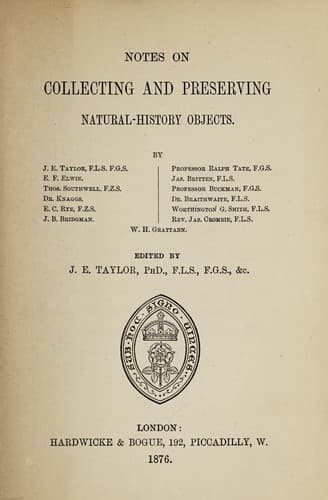
Notes on Collecting and Preserving Natural-History Objects
Science
Notes on Collecting and Preserving Natural-History Objects
Botanical specimens -- Collection and preservation; Zoological specimens -- Collection and preservation
As regards the particular time of day to collect with advantage, it
has already been implied that a search in an open country should be
prosecuted after a shower of rain, or during early morn. In damp woods,
where throughout the day the air is sufficiently moist to maintain the
animals in full activity, no such considerations determine the best
time for collecting. In such places, light is usually the desideratum,
and consequently I have found that a search conducted at midday in a
clear sky has been amply rewarded.
Land snails exhibit a partiality for calcareous soils, not only by
those living on downs and hill-sides, but also by the woodland species.
Having spent the forenoons of three days in gathering slugs and snails
as before detailed, one evening was devoted to the preparation of the
specimens for the cabinet.
The first step was to remove the animals, and, as all know, it is
neither an easy nor a clean task to separate the living snail and
its house; but kill your snail, and the muscular connection with the
shell being severed, its whole body is readily taken out by means of a
pin--why, it is just like picking periwinkles; and if the proclivities
of our childhood's days are not entirely obliterated, cleaning out
larger snails from their shells will be a task requiring no teaching.
But, with regard to the smaller kind, it is another matter, and it will
be my duty to show you how to set about the work.
Now pick out those shells, the apertures of which are wide enough, as
it seems to you, to permit the removal of the dead body of the snail
by a pin. You may also place with them the larger bivalves. All these
we will boil to kill the animals; then strain off the water, and wash
with cold water. By this means the bodies contract, and being firmer
are not so liable to be broken in the process of removal. Shake the
water out of the empty shell, and place them before the fire to dry;
do not rub them, but particles of dirt may be gently flicked off by
the aid of a camel-hair brush. Thus we treat the larger snails. Now
for the mussels. Doubtless most of the dead bodies will have fallen
out between the open valves while in the water; should any remain, a
slight shaking of the shell held by the hand in the water will remove
the contained body. Taken from the water, the valves gape widely; dry
the inside and outside with a cloth, and having tape or cotton at
hand, close the valves by the pressure of the thumb and fingers of the
one hand, and with the end of the thread between your teeth, wind the
thread two or three times around the shell with the other; now tie the
thread as tight as you can. "Yes, I have done so, but still the valves
are not closed." True, this is because of the elasticity of thread. If,
however, you will take the precaution to wet the thread before tying,
you will find that the tie is more secure, and that there is less
difficulty in making the second knot.
Public-domain text, read in full here on John Shaqi.
Reviews
Reviews
No reviews yet
Be the first to share your thoughts on this work.
Join the Discussion
Join the discussion
Sign in to leave a comment or review.
Sign InorCreate an account