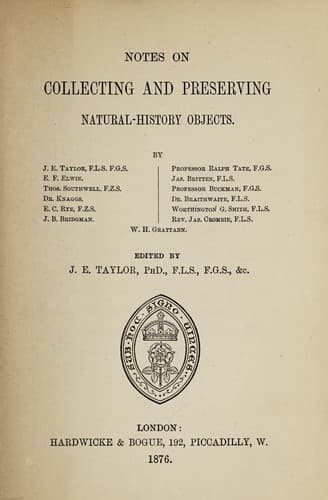
Notes on Collecting and Preserving Natural-History Objects — John Shaqi
Notes on Collecting and Preserving Natural-History Objects
Science
Notes on Collecting and Preserving Natural-History Objects
Botanical specimens -- Collection and preservation; Zoological specimens -- Collection and preservation
The number of estuarine species which have a place in our works devoted
to British land and freshwater snails is very few, and the majority,
moreover, are confined to the margins of the tidal rivers in the south
of England. Thus _Assiminea Grayana_, _Hydrobia ventrosa_, and _H.
similis_, live on the mud banks beneath the shade of sedges and rushes,
skirting the Thames below Greenwich. To gather these small shells
singly is a tedious operation; but if a thin piece of flat wood, or
other substitute as the ingenuity of the collector suggests, be used to
scrape lightly over the surface of mud, transferring the mass to the
_dredger_, and washing in water, a number of specimens sufficient to
stock every private cabinet in the country may be obtained in a short
space of time.
For the third initiatory excursion our steps were directed inland, and
as we proceeded the hedgerows, mossy banks, and margins of watercourses
were diligently searched, finding a _Helix_ here, a _Pupa_ or a
_Succinea_ there. Gaining the woods, we turn over the damp leaves, grub
under the clumps of ferns and wood-rushes for small Helices, Pupæ, and
the like; scan the trunks of the trees for the climbing _Clausiliæ_,
_Bulimi_, and _Helices_, not unmindful that each little dirt-like mass
is probably a _Bulimus obscurus_, which, by covering its shell with
mud, thus exhibits a protective faculty, and often escapes detection.
Raise the rotting bark for _Balia_; lift the stones at our feet, or
roll away a log for _Helicella_, and other small shells which usually
live in such situations.
From all this we learn that each species affects certain stations, and
therefore, with the knowledge of the circumstances in which they are
found, we may set out with some definite idea as to what we are likely
to meet with; and, in consequence, when to collect and where to collect
are regulated by the unvarying habits of the objects of our search.
Now, a large portion of the life of most land snails is passed in a
state of sleep. Those living in open situations are inactive during the
heat of a summer's day, and when there is continued drought; but on the
first shower, or after the fall of dew at night, they recover and move
about in search of food. Cold acts much in the same way as heat, and
with the fall of the leaf they retire to winter quarters in crannies of
rocks, crevices of walls, under heaps of decaying vegetation, &c., or
bury themselves in the soil, there to hybernate till the genial showers
of spring awaken them.
The best time of the year for collecting is in the autumn, when the
shells are full-grown. Those collected in spring have lost much of
their original beauty by exposure to the rains and cold of the winter
months.
Public-domain text, read in full here on John Shaqi.
Reviews
Reviews
No reviews yet
Be the first to share your thoughts on this work.
Join the Discussion
Join the discussion
Sign in to leave a comment or review.
Sign InorCreate an account