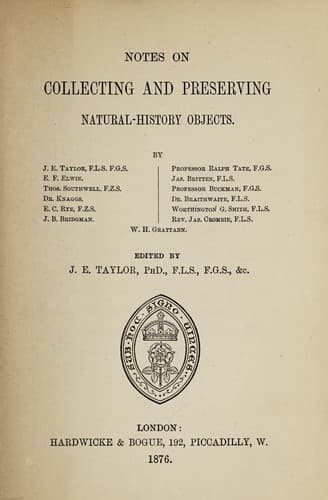
Notes on Collecting and Preserving Natural-History Objects
Science
Notes on Collecting and Preserving Natural-History Objects
Botanical specimens -- Collection and preservation; Zoological specimens -- Collection and preservation
"As regards the internal shell, it may be obtained by making a conical
incision in the shield, taking care not to cut down upon the calcareous
plate, which can then be removed without difficulty. The animals
can only be conserved by keeping them in some preservative fluid;
but the great object to keep in view is to have the slug naturally
extended. Most fluids contract the slugs when they are immersed in
them. The slugs should be killed whilst crawling, by plunging them
into a solution of corrosive sublimate, or into benzine. Models in
wax or dough are sometimes substituted for the animals. A writer in
the 'Naturalist' gives a process for the preservation of slugs, which
he states to answer admirably, and to be very superior to spirit,
glycerine, creosote, and other solutions:--'Make a cold saturated
solution of _corrosive sublimate_; put it into a deep wide-mouthed
bottle; then take the slug you wish to preserve, and let it crawl upon
a long slip of card. When the tentacles are fully extended, plunge it
suddenly into the solution; in a few minutes it will die, with the
tentacles fully extended in the most life-like manner; so much so
indeed, if taken out of the fluid it would be difficult to say whether
it be alive or dead. The slugs thus prepared should not be mounted
in spirit, as it is apt to contract and discolour them. A mixture of
one and a half parts of water and one part of glycerine, I find to
be the best mounting fluid. It preserves the colour beautifully, and
its antiseptic qualities are unexceptionable. A good-sized test-tube
answers better than a bottle for putting them up, as it admits of
closer examination of the animal. The only drawback to this process
is, that unless the solution is of sufficient strength, and unless the
tentacles are extruded when the animal is immersed, it generally, but
not invariably, fails. Some slugs appear to be more susceptible to the
action of the fluid than others; and it generally answers better with
full-grown than with young specimens. But if successful, the specimens
are as satisfactory as could be desired; and even if unsuccessful, they
are a great deal better than those preserved in spirit; for, although
the tentacles may not be completely extruded, they are more or less
so'".
The Testacellæ I have treated in the following manner: by partially
drying them in sand, and removal of the soft parts through a cut in the
length of the foot, filling up with cotton wool and a renewal of the
drying.
Public-domain text, read in full here on John Shaqi.
Reviews
Reviews
No reviews yet
Be the first to share your thoughts on this work.
Join the Discussion
Join the discussion
Sign in to leave a comment or review.
Sign InorCreate an account