Notes on Collecting and Preserving Natural-History Objects — John Shaqi
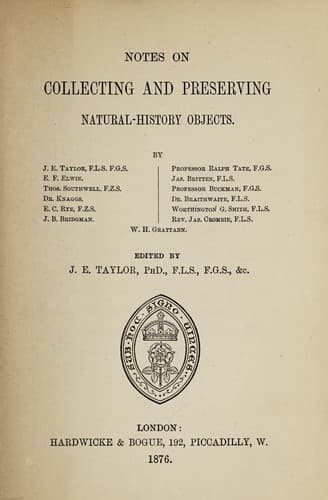
Notes on Collecting and Preserving Natural-History Objects
Science
Notes on Collecting and Preserving Natural-History Objects
Botanical specimens -- Collection and preservation; Zoological specimens -- Collection and preservation
Our land and freshwater snails have other structures besides their
shells which should claim our attention. These, which include their
jaws, tongues, and some other minute parts, are not so inaccessible
as one is at first too apt to consider, and are deservedly in favour
as microscopic objects requiring a low power. I shall assume that
the collector has preserved the bodies or the heads of the snails
in spirit, which he has removed from their shells in the process of
preparing them for his cabinet. He will take care to keep separate the
animals of each species.
A last word upon the mode of displaying the shells in the cabinet. Here
one has considerable choice, as they may be kept in open card trays,
or in glass-topped boxes, or gummed on cards, papered boards, or glass
tablets. Loose specimens admit of ready examination, whilst the method
of mounting permits an arrangement of individuals according to size and
locality, and is much to be preferred.
VIII.
FLOWERING PLANTS AND FERNS.
By James Britten, F.L.S.
PART I.
The kindred subjects of the collecting of plants and their arrangement
in the herbarium have been treated of over and over again, and it might
almost seem as though nothing further need be said upon the matter. But
in spite of all that has been written, it cannot be said that anything
like uniform excellence has been attained, either in the collecting
or drying of specimens: on the contrary, much carelessness is still
exhibited in both particulars, and the following remarks on the subject
may therefore be useful to some, at any rate, among the readers of
'Science Gossip.' It has been found impossible to treat both points
adequately in one paper, so, on the present occasion, we shall devote
ourselves to collecting, leaving the arrangement and matters connected
therewith for another occasion.
[Illustration: Fig. 31. Young Plant of _Ipomæa Quamoclit_
(from Decandolle's 'Organographie').]
Public-domain text, read in full here on John Shaqi.
Reviews
Reviews
No reviews yet
Be the first to share your thoughts on this work.
Join the Discussion
Join the discussion
Sign in to leave a comment or review.
Sign InorCreate an account