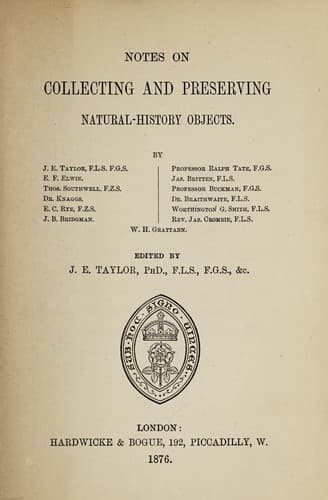
Notes on Collecting and Preserving Natural-History Objects
Science
Notes on Collecting and Preserving Natural-History Objects
Botanical specimens -- Collection and preservation; Zoological specimens -- Collection and preservation
dicotyledonous; or even to be acotyledonous, as is the case with the
dodder (_Cuscuta_). In the latter-named genus, it is of importance to
collect young specimens, as showing that the plant, although parasitic
as soon as it comes in contact with a suitable foster-plant, is of
independent origin. A search among young plants will no doubt lead to
the discovery of some abnormalities, such as tricotyledonous embryos
and other irregularities. Of some plants, such as the furze, the true
leaves can only be found at an early stage of growth; in others, much
variation may be noted in many points between the first leaves and
the more perfect ones which succeed them; some, as the holly, at once
developing leaves similar to those which are produced throughout the
life of the plant, and others going through many modifications before
the ultimate shape is attained, as in the ash, elder, ivy, maple, &c.
The roots or rhizomes also require to be much more fully represented
and carefully collected than is usually the case. In every instance
where the size of the plant does not prevent, the subterranean and
subaqueous parts should be carefully procured and preserved.
Dr. Trimen has lately directed attention to the corm-like tubers of the
water plantain (_Alisma_),[G] closely resembling those of the arrowhead
(_Sagittaria_), which have been described and figured by Nolte, but
"do not seem to have been observed, or at least properly understood,
in this country. They are buds remaining dormant through the winter,
and containing a store of nutriment, to be employed in the development
of the new plant from the tuber in the next year." Similar bulbs are
developed by the frogbit (_Hydrocharis_). In determining many grasses
and rushes, it is of importance to ascertain whether the rhizome is
creeping or cæspitose, and it is therefore essential to collect good
specimens. In the case of such plants as the coral-wort (_Dentaria
bulbifera_) and toothwort (_Lathræa squamaria_), the root-stocks
are eminently characteristic. Of such parasites as the broomrapes
(_Orobanche_), some care is requisite in obtaining specimens in which
the connection between the parasite and its foster-plant may be
preserved and shown. The absence or presence of tubers should also be
noted, and if present, they must be represented.
[G] 'Journal of Botany,' 1871, p. 306.
Public-domain text, read in full here on John Shaqi.
Reviews
Reviews
No reviews yet
Be the first to share your thoughts on this work.
Join the Discussion
Join the discussion
Sign in to leave a comment or review.
Sign InorCreate an account