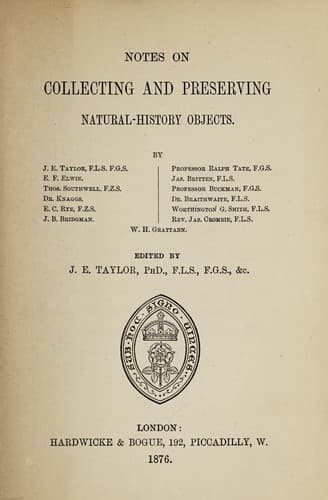
Notes on Collecting and Preserving Natural-History Objects
Science
Notes on Collecting and Preserving Natural-History Objects
Botanical specimens -- Collection and preservation; Zoological specimens -- Collection and preservation
Passing on to the leaves, we may note the importance of obtaining
in every case the root-leaves of each species. These are often very
different in form from the stem-leaves, as in such species as the
harebell (_Campanula rotundifolia_), _Pimpinella saxifraga_, the
earth-nut (_Bunium flexuosum_), and many more; in some instances, as in
the Jersey bugloss (_Echium plantagineum_), they at once characterize
the species. Still more important are these lower leaves in the case of
water-plants: in the arrowhead (_Sagittaria_), for example, they are
narrow, and resemble those of the bur-reed (_Sparganium_); and in the
water plantain (_Alisma plantago_), the submerged leaves are equally
different from those which rise out of the water. This difference is
still more noticeable in the case of the aquatic _Ranunculi_, where a
knowledge of the submerged leaves is essential to the discrimination of
the various forms or species.
Where practicable, the whole plant should be collected for the
herbarium; but when, from its size, this cannot be accomplished, leaves
from the root, the centre of the main stem, and the lateral branches,
should be taken. As to the stem itself, that must be represented: in
the _Rubi_, indeed, it is essential. "To judge properly of a bramble
from a preserved specimen," says Professor Babington, "we require a
piece of the middle of the stem with more than one leaf; the base and
tip of the stem are also desirable, likewise a piece of the old stem
with the flowering shoot attached to it; the panicle with flowers,
and the fruit. We likewise want to know the direction of the stem
throughout, of the leaflets, and of the calyx; also the shape of the
petals and the colour of the styles: a note of these should be made
when the specimen is gathered."
Passing on to the flowers, we shall find it necessary to represent
them in almost every stage, from the bud to the perfecting of the
fruit. It is of course in most cases possible to select an example
in such a state as to show upon the same plant buds, flowers, and
fruits; but where this is not the case, each of these particulars must
be supplemented by additional specimens. The turn which botanical
investigation has recently taken towards the study of the phenomena
connected with fertilization has given the collector another subject to
which his attention may be profitably directed. It has been observed
that in some plants the stamens are developed before the pistils;
in others, the pistils are matured before the stamens; while in
yet a third set, stamens and pistils are simultaneously perfected.
These three groups of plants are termed respectively protandrous,
protogynous, and cynacmic, and a very little observation will show that
examples of each are sufficiently common.
Public-domain text, read in full here on John Shaqi.
Reviews
Reviews
No reviews yet
Be the first to share your thoughts on this work.
Join the Discussion
Join the discussion
Sign in to leave a comment or review.
Sign InorCreate an account