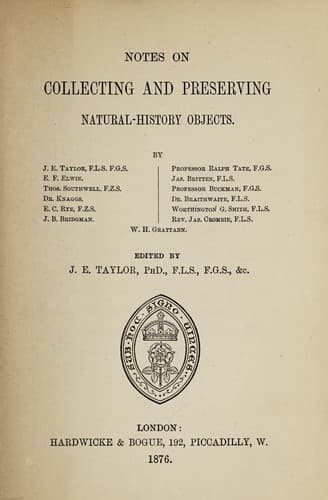
Notes on Collecting and Preserving Natural-History Objects
Science
Notes on Collecting and Preserving Natural-History Objects
Botanical specimens -- Collection and preservation; Zoological specimens -- Collection and preservation
Then in dioecious and monoecious plants, both male and female
flowers must be collected, and in some cases, as in the willows, four
specimens are necessary to the complete presentment of the species,
showing respectively the male and female catkins, the leaves, and
the fruit. Some plants produce two distinct forms of blossom, as is
noticeable in the violets and the woodsorrel, one being conspicuous
and usually barren, the other insignificant and often apetalous, but
producing perfect fruit. The pollen will afford occupation to the
microscopist: the researches of Mr. Gulliver and Mr. Charles Bailey
have demonstrated that important distinguishing characters are in some
instances furnished by it. While on this point it may be suggested
that it is convenient in many cases to collect several specimens of
the flowers alone, which, when dried, should be placed in a small
envelope or capsule, and attached to the sheet on which the plant is
represented. In the event of any examination which may be requisite
after the plant is dried, these detached blossoms will be found very
useful, and will prevent the necessity of damaging the specimen. In
the case of such plants as shed their corollas very readily, as the
speedwells, it is as well to put them in press as soon as collected;
and the colour of many may be retained by the same means.
The fruits and seeds of plants are too generally neglected by amateur
collectors, but are essential to the completeness of a specimen. It
may be found practically convenient to keep these in a separate place,
and detached from the plant; and in many cases of dried fruits it is
advisable to sort them into their places without previous pressing.
By this means the modes of dehiscence will readily be seen: pulpy and
succulent fruits should be preserved in spirit. In such plants as the
species of sea sandwort (_Lepigonum_), and some Chenopodia, important
specific characters are drawn from the seed; as they are from the pods
of _Melilotus_ and the fruits of _Agrimonia_. In collecting ferns,
well-fruited fronds must be selected, as it is impossible to determine
specimens without fructification. Grasses should be selected when in
flower and fruit, but must not be allowed to attain too great an age
before they are collected.
Public-domain text, read in full here on John Shaqi.
Reviews
Reviews
No reviews yet
Be the first to share your thoughts on this work.
Join the Discussion
Join the discussion
Sign in to leave a comment or review.
Sign InorCreate an account